Category: B2B Marketing

  • AEO vs GEO vs SEO: What Every B2B Marketer Needs to Know

    AEO vs GEO vs SEO: What Every B2B Marketer Needs to Know

    AEO vs GEO vs SEO: What Every B2B Marketer Needs to Know

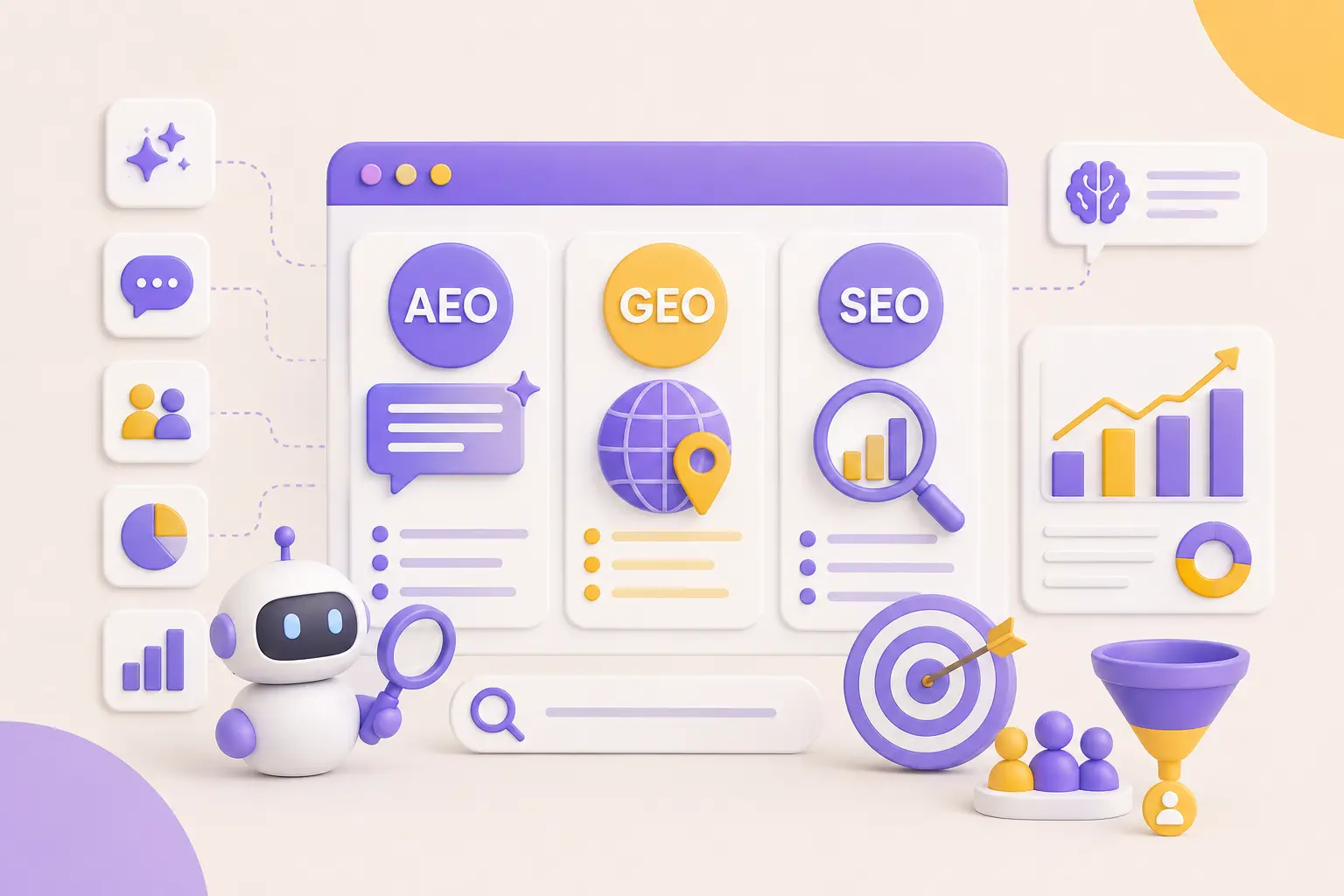
    Three years ago, B2B marketing teams had one organic search discipline to manage. Today they have three – SEO, AEO, and GEO – each with distinct signals, different content requirements, and separate measurement frameworks. The teams treating them as the same thing are investing in the wrong places. The ones that have separated them are building compounding advantage.

    This guide is the clear breakdown your team needs: what each discipline actually is, how it differs from the others, where they overlap, and how to allocate resources across all three without spreading effort so thin it produces nothing.

    40%+of informational B2B queries now trigger a Google AI Overview, bypassing organic click-through3 in 5B2B buyers use ChatGPT, Perplexity, or Gemini during the vendor research process< 15%of B2B marketing teams currently run separate strategies for SEO, AEO, and GEO

    1. The definitions: SEO, AEO, GEO, and LLMO in plain language

    Before the comparison, the definitions. Each term is being used loosely across the industry. Here’s what each one precisely means:

    SEOSearch Engine OptimisationGetting your website to rank in the organic results of traditional search engines

    SEO is the discipline most marketing teams know best. It optimises for ranking position in Google’s classic organic results – the blue links that appear beneath ads and above AI Overviews. The primary signals are: backlink authority, on-page relevance, technical health (crawlability, page speed, Core Web Vitals), and topical depth.

    In 2026, classic SEO is still the highest-volume organic traffic channel for most B2B companies. Its influence on pipeline hasn’t diminished. What has changed is the share of queries where a click to your site is the default outcome – AI Overviews and direct answers intercept an increasing portion before the user reaches organic results.

    AEOAnswer Engine OptimisationGetting your content cited inside AI-generated answers on search engine result pages

    AEO targets the surfaces inside search engines that generate answers without requiring a click to your site. In Google’s case, this means AI Overviews (the synthesised answer box appearing above organic results), featured snippets, and voice search results. Bing’s Copilot integration operates similarly.

    AEO optimisation focuses on: placing direct 2–3 sentence answers immediately below relevant headings, structuring content with FAQPage schema that mirrors on-page Q&A, maintaining heading hierarchies that match natural-language query phrasing, and building topical authority across a cluster of interlinked pages rather than relying on a single page.

    A key distinction: AEO is about being cited inside the search engine. The user may see your brand in the answer without clicking to your site. For B2B marketing teams, this brand impression at a high-intent moment has real value even without a recorded session in GA4.

    GEOGenerative Engine OptimisationGetting your content cited by AI tools when users ask research, comparison, or evaluation questions

    GEO operates outside of traditional search engines entirely. It targets the answers generated by ChatGPT, Perplexity, Claude, Gemini, and similar AI tools when users ask research-style questions. These tools retrieve content from the web using retrieval-augmented generation (RAG), synthesise it, and present a generated answer that may cite specific sources.

    GEO optimisation focuses on: consistent entity naming across all on-site and external content, original data or frameworks that give AI systems a reason to cite your specific content, clean HTML structure that AI crawlers (GPTBot, PerplexityBot, ClaudeBot) can parse accurately, and topical depth signals that help AI systems classify your domain as authoritative on a subject.

    The GEO measurement challenge is significant: a significant portion of GEO value is delivered through brand mention in AI-generated answers that produce no trackable click. Marketing teams used to last-click or even multi-touch attribution will undercount GEO impact using standard analytics.

    ✺ WHAT ABOUT LLMO?LLMO (Large Language Model Optimisation) describes the broader discipline of shaping how LLMs represent your brand, products, and expertise in their training data and retrieval systems. GEO focuses on retrieval – being cited in real-time AI-generated answers. LLMO includes training data influence, which operates on a longer timeline and through a different set of signals (external authority, original research, third-party citations).For most B2B marketing teams in 2026, GEO is the actionable short-to-medium-term discipline. LLMO is the longer-arc brand investment running in parallel. This guide focuses on GEO as the operational priority.

    2. How each discipline works: retrieval, ranking, and citation

    The mechanism behind each discipline determines what you optimise. Get the mechanism wrong and you’re applying the right effort to the wrong signals.

    DisciplineMechanismWhat the system looks forOutput for the user
    SEOCrawl → index → rank. Google crawls pages, indexes content, and ranks pages against queries using hundreds of signals.Backlink authority, keyword relevance, technical health, topical depth, page experience signals (Core Web Vitals).A ranked list of organic results. User clicks through to your site.
    AEOCrawl → index → retrieve → synthesise. Google retrieves relevant indexed pages and uses an LLM to generate a synthesised answer.Direct-answer text structure, FAQPage schema accuracy, heading hierarchy matching query intent, domain topical authority.A synthesised answer box (AI Overview) above organic results. May include a source link. Often no click required.
    GEOCrawl → retrieve → synthesise (RAG). AI tools fetch live web content at query time, use it as context, and generate an answer.Clean HTML parsability, entity consistency, topical depth across a domain, original data/frameworks, source credibility signals.A generated answer in ChatGPT, Perplexity, Claude, etc. May include source citations. User may or may not visit the cited site.

    The practical implication: SEO and AEO share the same Google index as their starting point. Content that ranks well in classic SEO has a meaningful head start for AEO, because it’s already trusted by Google’s crawl systems. GEO operates independently – a page that ranks on page 3 of Google can still be cited by Perplexity if it covers a specific question with strong structural clarity and entity signals. This creates both a risk (poor classic SEO doesn’t preclude GEO entirely) and an opportunity (GEO investment is accessible even for domains with moderate domain authority).

    3. The side-by-side comparison every marketer needs

    FactorSEOAEOGEO
    Primary surfaceGoogle organic results (blue links)Google AI Overviews, Bing Copilot, featured snippets, voiceChatGPT, Perplexity, Claude, Gemini, Copilot (standalone)
    Output for userRanked list; user clicks through to your siteSynthesised answer; source link may or may not be shownGenerated answer; source citation often visible in Perplexity
    Traffic to your siteDirect – every ranking drives potential clicksPartial – AI Overview may reduce clicks on same queryIndirect – citation may or may not drive a click
    Primary signalsBacklinks, keyword relevance, technical health, CWVAnswer structure, FAQPage schema, heading hierarchy, authorityEntity clarity, HTML parsability, topical depth, original data
    Schema priorityStandard (title, meta, breadcrumb)FAQPage, Article, HowTo – these drive Overview selectionOrganization, Article, FAQPage, SoftwareApplication
    Content format that winsWell-optimised long-form with strong backlink profileDirect-answer openings; FAQ sections; structured H2/H3Extractable paragraphs; original claims; named frameworks
    Timeline to results3–6 months for competitive terms4–8 weeks after schema and structure changes4–12 weeks; varies by how frequently AI tools re-crawl
    Measurable in GA4Yes – organic sessions, conversionsPartially – Overview impressions in GSC; click data limitedPartially – referral traffic from Perplexity/ChatGPT trackable
    Budget intensityHigh – content, links, technicalModerate – content structure + schema changes to existing pagesModerate – entity standardisation + content depth investment
    B2B marketing priorityFoundational – must run alwaysHigh and growing – AI Overviews now affect most B2B info queriesHigh and emerging – buying committee research increasingly AI-assisted

    4. Where the three disciplines overlap and where they diverge

    Where they share the same foundation

    All three disciplines start with the same prerequisite: a technically sound, crawlable website with clean HTML, correct canonical structure, and accurate schema. A robots.txt that blocks AI crawlers hurts GEO and AEO simultaneously. JavaScript rendering failures affect classic Google indexing and AI retrieval equally. Core Web Vitals matter for both user experience and crawler completion rates across all three systems.

    Topical authority also lifts all three. A domain that has built systematic coverage of a subject area – pillar page, cluster pages, interlinked with descriptive anchors – performs better in classic SERP rankings, earns more AI Overview citations, and gets retrieved more reliably by external AI tools. The content architecture investment is shared.

    Where they diverge

    The divergence is in content structure and signal weighting. A page optimised for classic SEO may rank on page 1 without ever appearing in an AI Overview, because it buries the direct answer deep in the content and has no FAQPage schema. That same page may not be cited by Perplexity because its HTML is cluttered and its entity naming is inconsistent.

    Optimisation actionHelps SEOHelps AEOHelps GEO
    High-authority backlink acquisition✓ Direct✓ Indirect (authority)✓ Indirect (authority)
    FAQPage schema implementation✓ Minor✓ Critical✓ Moderate
    Direct 2–3 sentence answer below H1✓ Moderate✓ Critical✓ Critical
    Entity name standardisation across site○ Minimal✓ Moderate✓ Critical
    Clean HTML / SSR rendering✓ Moderate✓ Moderate✓ Critical
    Robots.txt allowing AI crawlers○ N/A○ N/A✓ Critical
    Original research / benchmark data✓ Moderate✓ Moderate✓ Critical
    Topical cluster architecture✓ Critical✓ High✓ High
    Page speed optimisation (LCP < 2.5s)✓ Moderate✓ Moderate✓ Moderate
    Crunchbase / Wikidata / external profile accuracy○ Minimal○ Minimal✓ High

    5. How B2B buyers interact with all three surfaces

    B2B buyers move across SEO, AEO, and GEO surfaces within a single buying cycle – often within a single research session. Understanding which surface they use at each stage is the foundation of a properly allocated multi-channel organic strategy.

    Buying stageTypical search behaviourSurface usedWhat your brand needs there
    Problem definitionTyping a symptom or failure into Google: “why is our sales pipeline accuracy declining”SEO (organic) + AEO (AI Overview on the query)A well-ranked, direct-answer article on that specific problem
    Category educationAsking ChatGPT or Perplexity: “explain revenue intelligence platforms and how they differ from CRM”GEO (LLM answer)Your brand and category definition cited in the generated answer
    Vendor shortlistingGoogling: “best revenue intelligence software for mid-market sales teams”SEO + AEO (AI Overview on category queries)Ranking in classic SERP + citation in AI Overview on that query
    Competitive comparisonAsking Perplexity: “[Vendor A] vs [Vendor B] for enterprise B2B”GEO (Perplexity or ChatGPT with browsing)Your comparison page cited as a source in the generated comparison
    Internal justificationGoogling: “ROI of revenue intelligence platforms for B2B sales”SEO + AEOA business-case page with specific benchmarks ranking and cited in AI Overview
    Final validationGoogling: “[Your brand] reviews” or “[Your brand] vs [Competitor]”SEO (branded organic)Your own comparison page ranking above G2 and Capterra on branded comparison queries
    ✺ THE CRITICAL IMPLICATION FOR B2B MARKETERSA B2B buyer evaluating your product may encounter your brand through six separate search events before a sales conversation – and those events are distributed across classic SERP, Google AI Overviews, and external AI tools. A strategy that optimises for only one of these surfaces captures one event and misses five. The ROI case for investing across all three disciplines is a coverage argument, not just a traffic argument.

    6. Which discipline to prioritise and when

    The right prioritisation depends on your current situation. Here’s the framework, by scenario:

    01You have weak organic foundations (DA < 25, few rankings)Start with SEO. AEO and GEO both benefit from the same technical and content foundations that classic SEO requires. Building topical authority through a cluster architecture, fixing technical crawl issues, and producing substantive content on your core topics lifts all three disciplines simultaneously. Investing in GEO-specific entity work before you have solid technical SEO is building the upper floors before the ground floor is stable.
    02You rank well but traffic from informational queries is decliningAdd AEO. If your existing rankings are producing fewer clicks than they did 12 months ago on informational queries, AI Overviews are the most likely cause. Audit which of your ranking pages are being intercepted by Overviews and audit whether you’re cited in them. The fix is structural: direct answers early in the content, FAQPage schema, heading hierarchy that matches query phrasing. This is an AEO intervention applied to existing SEO-performing content.
    03Your buyers use AI tools heavily in research (confirmed by sales team)Invest in GEO alongside SEO. If your sales team reports that prospects are arriving having already formed opinions about your category from ChatGPT or Perplexity, your GEO presence is already influencing pipeline. Audit your entity representation in AI tools, standardise entity naming across all content, and add direct-answer structure to your most important pages. GEO investment produces returns faster than SEO on competitive terms because it doesn’t depend on backlink accumulation.
    04You compete in a regulated or niche vertical (FinTech, cybersecurity, healthcare tech)Prioritise GEO with vertical-specific depth content. Regulated B2B verticals have compliance, regulation, and certification queries that buyers increasingly research through AI tools. A FinTech vendor with authoritative content on PSD2, FCA authorization, and PCI DSS will be cited in regulatory-context AI answers in ways a generic financial technology vendor won’t. Build vertical-specific cluster content with direct-answer structure and let it compound across both AEO and GEO surfaces.
    05You have strong SEO and AEO performance but limited GEO presenceRun a targeted GEO programme. Audit your entity representation in ChatGPT, Perplexity, and Gemini explicitly. Check: does the AI accurately describe what your company does? Does it mention your product in relevant category comparisons? Fix entity inconsistencies, add original research to key pages, ensure GPTBot and PerplexityBot are allowed in robots.txt, and implement Organization and SoftwareApplication schema. This is an optimization programme on an existing strong content base.

    7. Building the integrated strategy

    Running SEO, AEO, and GEO as separate workstreams with separate teams is operationally inefficient. The disciplines share enough infrastructure that an integrated programme produces better results with lower resource duplication.

    Here’s how the integrated programme works in practice:

    ✺ SHARED FOUNDATIONTechnical layer (serves all three)Clean crawlable HTML, correct robots.txt for all crawlers, fast page load (LCP < 2.5s), canonical structure, sitemap accuracy. Fix once, lift all three disciplines simultaneously. Audit quarterly.✺ SHARED FOUNDATIONContent architecture (serves all three)Pillar + cluster structure with descriptive internal linking. A well-built topic cluster raises classic rankings, builds topical authority for AI Overview citation, and signals domain expertise to GEO retrieval systems.
    ✺ AEO-SPECIFIC LAYERAnswer structure + schemaDirect 2–3 sentence answers below H1/H2 headings. FAQPage schema on blog, pillar, and service pages. Article schema on all content. HowTo schema on step-by-step guides. These additions to existing content are low-effort and high-impact for AEO.✺ GEO-SPECIFIC LAYEREntity standardisation + original dataConsistent entity naming across all pages, schema blocks, and external profiles. At least one piece of original data, a proprietary framework, or a named benchmark on each key page. These are the citation anchors that give AI tools a specific reason to reference your content over a competitor’s.
    ✺ SEO-SPECIFIC LAYERAuthority and backlink programmeExternal link acquisition remains the most decisive signal for classic SERP ranking that AEO and GEO don’t require in the same way. A focused backlink programme on pillar pages and high-priority comparison pages is the SEO-specific investment that doesn’t overlap.✺ MEASUREMENT LAYERCross-discipline trackingGSC for classic ranking and AI Overview impressions. GA4 + CRM for organic pipeline influence. Monthly manual citation audit for GEO. Quarterly entity representation check in ChatGPT and Perplexity. One integrated reporting dashboard, not three separate ones.

    8. Measuring performance across all three disciplines

    Standard marketing analytics was built for a world where organic traffic meant a click. The multi-surface reality of 2026 requires a measurement framework that accounts for impressions and citations that produce no trackable session.

    DisciplinePrimary metricSecondary metricsToolReporting cadence
    SEOOrganic sessions + qualified leads from organicKeyword rankings by cluster; organic conversion rate by page; assisted conversions in GA4Google Search Console, GA4, Ahrefs / Semrush, CRM integrationWeekly rank check; monthly pipeline report
    AEOAI Overview impressions + share of cited pagesFeatured snippet position; click-through rate on Overview-intercepted queries; GSC impression shareGoogle Search Console (AI Overview filter); manual query auditMonthly Overview impression report; quarterly content audit
    GEOBrand mention rate in AI tool answers (manual audit)AI-referred referral traffic in GA4; entity accuracy score; citation quality (source or mention)GA4 (referral source filter for Perplexity/ChatGPT); monthly manual citation audit spreadsheetMonthly manual audit; quarterly entity accuracy check
    ✺ THE MEASUREMENT GAP TO ACCEPTA portion of GEO and AEO value is unmeasurable with current tools – specifically, the brand awareness generated by citations and mentions in AI-generated answers that produce no click. This is structurally similar to radio advertising or event sponsorship: real value, untrackable in analytics. Marketing teams that refuse to invest in AEO or GEO until they can prove direct attribution will underinvest in these surfaces until competitors have built compounding advantages. Set a budget line for AI search optimization and measure what you can, accepting that full attribution isn’t available yet.

    9. The most common mistakes marketing teams make

    Here are the B2B SEO Mistakes:

    Mistake 1: Treating AEO and GEO as advanced SEO

    The framing of AEO and GEO as “SEO 2.0” leads teams to believe they need to master classic SEO fully before approaching the other disciplines. The reality: AEO and GEO have some unique requirements (direct-answer structure, entity standardisation, schema specifics) that can be addressed in parallel with classic SEO work. A mid-sized B2B company with moderate rankings should be running all three disciplines simultaneously, at different resource weights.

    Mistake 2: Publishing AEO/GEO content without fixing technical access

    Producing answer-optimised content on pages that GPTBot or PerplexityBot can’t crawl is wasted effort. Check robots.txt first. Then confirm key pages render fully for crawlers that don’t execute JavaScript. These two checks take an hour and determine whether all subsequent GEO effort reaches its target.

    Mistake 3: Optimising schema without matching on-page content

    FAQPage schema that includes questions and answers not visible on the page is a Google quality signal violation. It produces worse AI Overview citation, not better. Schema must reflect on-page content exactly – both the question text and the answer text. Audit this after every page update.

    Mistake 4: Measuring GEO with last-click attribution

    A B2B buyer who reads a Perplexity answer citing your brand and then directly types your URL three days later gets attributed to Direct in standard GA4 setups. Last-click attribution makes GEO look like it produces no traffic. Set up referral source tracking specifically for Perplexity, ChatGPT, and similar tools, and accept that a significant portion of GEO impact will remain in the unmeasured brand awareness bucket.

    Mistake 5: Running AEO and GEO as a one-time project

    AI search surfaces update constantly. Google’s AI Overview sourcing changes as the index evolves. LLMs re-crawl content on varying schedules. Entity representation in AI tools reflects the most recently available web signals. AEO and GEO require the same ongoing maintenance as classic SEO – monthly audits, quarterly content reviews, and continuous schema validation. Teams that launch a GEO programme and stop after six weeks build nothing that compounds.

    10. FAQ

    What is the difference between AEO, GEO, and SEO?

    SEO (Search Engine Optimisation) gets your pages ranked in traditional Google organic results that users click through to. AEO (Answer Engine Optimisation) gets your content cited inside AI-generated answers on search engine results pages – primarily Google’s AI Overviews – where the user may receive an answer without clicking to your site. GEO (Generative Engine Optimisation) gets your content cited by external AI tools like ChatGPT, Perplexity, and Claude when users ask research or comparison questions. All three disciplines share technical foundations but diverge in content structure, schema requirements, and measurement approach.

    Which is more important for B2B marketing: SEO, AEO, or GEO?

    All three matter, but at different weights depending on your situation. Classic SEO remains the highest-volume organic channel and the foundation the other two depend on. AEO is the highest near-term priority adjustment for most B2B marketing teams because Google AI Overviews are already reducing click-through on informational queries that previously drove traffic. GEO is the fastest-growing area of B2B buyer research behaviour and the most underprepared surface for most companies. The right answer is an integrated programme that allocates the majority of resource to SEO fundamentals, with dedicated investment in AEO content structure and GEO entity work running simultaneously.

    Can you optimise for all three at the same time?

    Yes – and the most efficient approach is to build a shared foundation that serves all three. Topic cluster architecture, technical crawl health, and direct-answer content structure all lift SEO, AEO, and GEO simultaneously. The discipline-specific additions are relatively lightweight on top of that foundation: FAQPage schema and heading restructuring for AEO, entity standardisation and robots.txt configuration for GEO. Running all three in parallel with a shared content team is more efficient than running them sequentially.

    How do you measure GEO performance when there’s no click data?

    GEO performance is measured through a combination of trackable and non-trackable signals. Trackable: referral traffic from Perplexity and ChatGPT (both pass referrer data), branded search volume trend in GSC, and entity accuracy in AI tool responses. Non-trackable: brand mentions in AI answers that produce no click. The non-trackable portion is structurally similar to brand awareness from offline channels – real value that can’t be attributed in analytics. The practical approach is a monthly manual audit: query your top 15 target terms in ChatGPT, Perplexity, and Google, and record citation status and accuracy. Track this alongside your trackable signals to build a directional picture of GEO performance.

    How long does it take to see results from AEO and GEO?

    AEO changes – adding direct-answer structure, FAQPage schema, and heading restructuring to existing pages – typically show AI Overview citation improvement within 4–8 weeks as Google re-crawls and re-evaluates the updated pages. GEO results depend on how frequently specific AI tools re-crawl your domain: Perplexity tends to update quickly (days to weeks for high-priority domains), ChatGPT’s browsing index updates on a variable schedule. Entity standardisation effects in GEO manifest over 4–12 weeks. Neither discipline delivers results as slowly as competitive classic SEO on high-authority terms, which is part of their strategic value.

    ✺ THE STARTING POINTThis week: run a manual citation audit across your top 10 target queries in Google AI Overviews, ChatGPT, and Perplexity. Map what you find against your current SEO rankings. The gap between where you rank and where you’re cited tells you exactly which disciplines need the most immediate investment.

    The Lemon Theory

    Growth marketing – strategy, SEO/AEO/GEO, performance, content. thelemontheory.com

    We build integrated SEO, AEO, and GEO strategies for B2B marketing teams – from audit through to implementation and measurement. Get in touch at thelemontheory.com.

  • How Google AI Overviews are going to affect your SEO traffic

    How Google AI Overviews are going to affect your SEO traffic

    Google AI Overviews answer many queries directly on the results page, so fewer people click through to websites. Pew Research Center (July 2025) found users clicked a link on 8% of searches that showed an AI Overview, against 15% without one. Informational and top-of-funnel pages lose the most traffic; high-intent and cited pages hold up.

    Most B2B SEO strategies were built for a results page that no longer exists. For 20 years the deal was simple: rank in the top three, earn the click, capture the visit. AI Overviews break that deal for a large share of informational searches. Google writes the answer at the top of the page and the user often gets what they came for without leaving. The loss isn’t evenly spread. Ranking still matters, and being quoted inside the AI Overview now matters as much.

    Key takeaways

    • AI Overviews cut click-through on informational and top-of-funnel queries. Pew Research Center (July 2025) measured an 8% link-click rate on searches with an AI Overview, against 15% without.
    • The traffic hit is uneven. “What is” and “how to” pages are most exposed. Comparison, pricing, product, and bottom-of-funnel pages hold up.
    • Getting cited inside an AI Overview is the new visibility. It rewards a clear answer near the top of the page, clean markup, existing top-5 rankings, and mentions elsewhere on the web.
    • Keyword volume is now a weak proxy for value. A query with an AI Overview can have high search volume and almost no clicks.
    • The first move is an audit of your top traffic pages, not a rebuild. Most sites need answer-structure fixes on 10–15 pages.

    What actually changes when an AI Overview appears

    When an AI Overview appears, Google generates a written answer above the organic results and cites a few sources inside it. Your organic listing gets pushed down the page, and a share of users get their answer without clicking anything.

    Google launched AI Overviews at I/O in May 2024 and expanded them through 2025. The mechanism has two effects. First, position: even at #1, the Overview sits above you, so your listing drops below the fold on most mobile layouts. Second, substitution: when the Overview answers the question fully, the click never happens. That’s what Pew Research Center measured in July 2025: an 8% link-click rate with an Overview present, against 15% without. [DATA — VERIFY: confirm Pew July 2025 figures before publishing.] Pew also found users clicked a source link inside the Overview about 1% of the time, so “we’ll win the citation referral” is weaker consolation than it sounds.

    Not every query triggers an Overview. Google shows them most on informational, research-style searches and rarely on transactional or brand queries. [DATA — VERIFY: current AI Overview trigger rate on B2B queries.] That split decides where your traffic is safe. For the wider picture, see our roundup of B2B digital marketing trends.

    Which pages lose traffic, and which hold up

    Exposure to AI Overviews tracks intent. The more generic and informational the query, the more likely Google answers it in the Overview and the more traffic you lose. The more specific or transactional the query, the safer the page.

    Page / query typeExposure to AI OverviewsWhy
    “What is” / definition pagesHighGoogle answers in two sentences. No reason to click.
    “How to” / basic guidesHighThe Overview summarises the steps inline.
    Listicles / “best X” roundupsMedium–HighOften synthesised into the answer, sometimes cited.
    Comparison (“X vs Y”) pagesMediumBuyers want detail and proof, so many still click.
    Original data / researchLow–MediumFrequently the cited source, which sends branded referral.
    Product / solution pagesLowBottom-of-funnel intent, not informational.
    Pricing pagesLowSpecific, transactional, and brand-owned.

    This is uncomfortable for a lot of B2B content plans, because the high-volume informational keywords those plans are built around sit in the top rows. A page targeting “what is marketing automation” is far more exposed than one targeting “marketing automation setup for [specific use case]”. That is why keyword volume has become a poor way to prioritise. A keyword with 12,000 monthly searches and a permanent Overview can send fewer real visits than one with 300 searches and none. The number that matters now is clicks you can win, not impressions Google might show. Pressure-test which target keywords still return a clickable results page before commissioning more posts.

    Getting cited is the new ranking

    Being cited inside an AI Overview is a distinct goal from ranking, and it’s earned differently. Google’s model picks sources that answer the specific question clearly, come from a trusted domain, and are structured so the answer can be lifted cleanly.

    From what’s visible so far, a few things correlate with citation. [DATA — VERIFY: Google has not published official citation criteria; treat these as observed patterns.]

    • A direct answer to the query in the first 100 words, written as a standalone statement a model can quote.
    • Pages already ranking in positions 1–5, since Overviews pull from sources Google trusts.
    • FAQ and how-to schema, and clean semantic markup.
    • Third-party mentions, so the model sees corroboration beyond your own site.

    None of that is new discipline. It’s the same relevance-and-authority work, aimed at extraction instead of the blue link. The practical shift is structural: stop burying the answer under 400 words of preamble. Say it in the first two sentences, then earn the rest of the read. This is where SEO and AEO overlap. AEO (Answer Engine Optimisation) applies the same idea to ChatGPT, Perplexity, and Google’s AI Mode, where buyers now research vendors before they reach your website. We treat this as one connected job rather than a separate line item, which is how we’ve built our services.

    What this means for B2B specifically

    B2B feels the shift harder than most sectors, because so much of the B2B funnel starts with informational research. The “how does X work” reading that used to land on your blog now often resolves inside an Overview or an AI chat tool, before a prospect knows your name.

    The consequence is specific. Awareness-stage traffic that fed retargeting pools and email lists thins out, so you have fewer people to nurture toward a demo. For any company that built its pipeline on top-of-funnel content, that’s a real gap. [DATA — VERIFY: your informational vs commercial organic split from Search Console.] The offset is that bottom-of-funnel intent is largely untouched. Someone searching “[your category] pricing” wants to act, and Google mostly leaves those results alone. So the sensible response is to rebalance: protect and expand the high-intent commercial pages that convert, and stop grading content on informational volume that AI now absorbs. There’s a credibility angle too. When a model chooses who to cite, it favours brands with third-party coverage and review-site presence, so off-site work (guest content, PR, getting quoted, G2 or Capterra listings) now feeds both classic search and AI answers.

    Should you stop investing in SEO?

    No. SEO still works for B2B, but the return has moved. Value is draining out of high-volume informational rankings and concentrating in high-intent commercial pages and in getting cited by AI. Cut the budget entirely and you lose the bottom-of-funnel demand capture that Overviews barely touch.

    The converting queries are the specific, commercial ones that were always your best traffic. Those buyers still search, compare, and click, because an AI summary doesn’t settle who to trust with a contract. What should change is the ratio. If your plan is 80% top-of-funnel pillar content and 20% commercial pages, that split now works against you. Weighting it toward the pages that either convert or get cited is a better use of the same budget. SEO isn’t the problem. A content strategy built for the 2020 results page is.

    What this looks like in practice

    For a UAE trade finance advisory, Express Trade Finance, we built the pipeline entirely on high-intent search. The programme ran on Google Ads and produced 100 high-intent leads a month, converting to high-value deals. [DATA — VERIFY: budget scale and campaign timeframe before publishing.]

    The relevant part here is why that structure holds up under AI Overviews. The queries we targeted were bottom-of-funnel and commercial: people looking for a specific financial service, ready to enquire. Those are the searches Google is least likely to answer inside an Overview, because a generated summary doesn’t help someone choose who to trust with a trade finance deal. The demand sat in the part of search AI isn’t absorbing.

    What we wouldn’t have recommended is chasing top-of-funnel informational keywords to “build awareness” first. It would have been slower, harder to attribute, and most exposed to substitution. Full write-up in the Express Trade Finance case study.

    Worth saying plainly: this was a paid-search programme, not an organic one. The principle transfers, since it’s about targeting buying intent, but we’re not claiming an organic ranking result we didn’t run.

    What most people get wrong

    The common reaction is to keep publishing informational content at the same rate and hope citation makes up for the lost clicks. It looks reasonable, because the pages still get impressions and the rankings still show. It costs you twice: you keep paying to produce pages that convert less, and you starve the commercial pages that would.

    The other error is treating AEO as a new service to buy later, separate from SEO. It isn’t a separate discipline. The work that gets you cited in an Overview (clear answers, clean structure, topical authority, off-site mentions) is the same work that ranks a page. Splitting them into two projects means paying twice for one job.

    For most B2B sites the fix is boring. Audit the top 10–15 traffic pages, find the ones targeting informational queries that now trigger Overviews, and either rebuild them around a direct answer or move that effort to commercial intent. No rebuild. No new retainer line. Just a harder look at what each page earns.

    Frequently asked questions

    Will AI Overviews kill my organic traffic?

    No, but they will reduce it on informational queries. Pew Research Center (July 2025) found link clicks roughly halved when an AI Overview was present (8% versus 15%). Commercial and bottom-of-funnel pages are largely unaffected, so your impact depends on how much traffic comes from “what is” and “how to” searches.

    Which of my pages are most at risk?

    Definition pages, basic how-to guides, and generic informational posts, because Google can answer those queries in a sentence or two. Comparison pages, pricing pages, product pages, and original research hold up, because they serve intent an AI summary can’t satisfy. Check your top traffic pages in Search Console against that pattern.

    How do I get my content cited in an AI Overview?

    Answer the query directly in the first 100 words, in a self-contained statement a model can lift. Add FAQ and how-to schema, keep the page technically clean, and build the topical authority that gets you into positions 1–5, since Overviews tend to cite pages that already rank. Third-party mentions help.

    Is AEO different from SEO?

    Not really. Answer Engine Optimisation aims the same relevance and authority work at AI answers instead of blue links. The techniques overlap almost completely: clear answers, structured markup, trusted domains, off-site citations. Treating them as one job is cheaper and more coherent than buying AEO as a separate service later.

    Do AI Overviews appear on B2B searches?

    Yes, and more often on the informational, research-style queries at the top of the B2B funnel. They appear far less on transactional and brand queries. The exact trigger rate for your category shifts over time, so check a sample of your own target keywords rather than trusting a blanket figure. [DATA — VERIFY: current B2B trigger rate.]

    How do I track traffic lost to AI Overviews?

    Google doesn’t label AI Overview impressions separately in Search Console yet, so it’s imperfect. Watch for pages holding their ranking position while click-through rate drops. That gap is the usual signature of an Overview appearing above you. Segment by query type to see whether informational pages fall faster than commercial ones.

    Where to start

    Pick your 10 highest-traffic informational pages this week. For each, rewrite the first 100 words so it answers the target query directly, in a statement a model could quote, then check whether the keyword still returns a clickable results page. That single pass tells you which pages to defend, rebuild, or retire.

    If you want the wider system this fits into, read our guide to building a full-funnel B2B strategy. And if you’d rather we ran the audit with you, book a growth audit.

  • Top SEO Mistakes That Cost B2B Tech Companies Qualified Leads

    Top SEO Mistakes That Cost B2B Tech Companies Qualified Leads

    Most B2B tech companies have an SEO problem they’ve misdiagnosed. The symptom looks like low organic traffic. The actual problem is a strategy built around the wrong objectives – rankings and sessions instead of qualified pipeline. Fix the objectives and most of the mistakes fix themselves.

    SaaS, cybersecurity, and FinTech operate in some of the most competitive B2B search landscapes on the planet. The vendors winning organic qualified leads in these verticals aren’t doing more SEO. They’re doing different SEO. The mistakes below are the specific gaps separating them from the companies spending serious budget on organic and wondering why the leads aren’t there.

    68%of B2B tech buyers complete more than half their evaluation before speaking to sales11average number of content pieces consumed by a B2B buyer before a vendor conversation< 3%average organic-to-lead conversion rate on typical B2B tech blogs – when it should be 5–12% for BOFU content

    Why B2B tech SEO specifically breaks down

    Generic SEO advice – the kind that applies equally to an e-commerce store and a Series B cybersecurity vendor – causes more damage in B2B tech than in almost any other category. The buyers are different. The sales cycle is different. The search behaviour is different.

    A SaaS buyer evaluating a $120,000 annual contract isn’t searching the way a consumer buying a $40 product searches. They research problems over weeks, not minutes. They involve procurement, legal, IT, and finance. They run searches specific to their industry, their compliance obligations, and their current tech stack. SEO that doesn’t account for this complexity produces traffic that feels good in dashboards and does very little in CRM.

    The following 10 mistakes are grounded in the specific search behaviours of SaaS, cybersecurity, and FinTech buyers. Each one has a clear fix. Most companies are making at least four of them simultaneously.

    #01Targeting informational keywords when buyers search problems

    This is the most common SEO mistake in B2B tech, and it compounds every other problem on this list. The assumption: target high-volume informational keywords in the category, build content around them, attract buyers. The reality: a FinTech company ranking for “what is open banking” attracts a very different audience than one ranking for “open banking API compliance for UK lenders.”

    B2B tech buyers search their problems, not their solutions. A cybersecurity buyer isn’t searching “SIEM software” in the early stages of evaluation. They’re searching “how to detect lateral movement in Azure AD” or “SOC team visibility gaps in multi-cloud environments.” A SaaS CFO isn’t searching “revenue recognition software” – they’re searching “ASC 606 compliance for subscription businesses.”

    The keyword research that produces qualified organic leads maps these problem-stage searches explicitly – by persona, by pain point, by industry context – and builds content around them. Volume-first keyword research produces the opposite.

    → THE FIXRebuild keyword research from buyer interviews and sales call transcripts. Ask: what did the buyer search before they found you? Map those queries, then build content around them – not around the category terms your product team prefers.For SaaS: focus on workflow-failure queries (“why does our churn model break”). For cybersecurity: threat and compliance-specific queries. For FinTech: regulation and integration-specific terms.
    #02Building TOFU content libraries with no BOFU coverage

    Walk through the blog archives of most B2B tech companies and you’ll find the same pattern: 80 awareness-stage articles, 15 mid-funnel guides, and almost no bottom-of-funnel content. The pages that drive qualified leads – comparison pages, alternative pages, use-case pages, pricing context pages – are absent. That space is filled by G2, Capterra, Gartner, and the competitors who had the discipline to build it.

    The reason is usually organisational. Content teams produce thought leadership because it feels brand-safe. Sales teams haven’t asked for SEO content. Product marketers own comparison messaging but aren’t running an SEO programme. The result is a content library that educates the market and sends ready-to-buy buyers to someone else’s comparison page.

    For a cybersecurity vendor, BOFU SEO looks like: “[Your product] vs [Competitor]”, “[Your product] for healthcare compliance”, “[Competitor] alternatives for mid-market”. For SaaS: “[Your product] pricing,” “best [category] software for [industry].” For FinTech: “[Your product] vs [Competitor] for FCA-regulated firms.” These pages rank faster, convert harder, and produce leads your sales team can work with.

    → THE FIXAudit your existing content by funnel stage. If less than 20% is BOFU, you have a content mix problem.Build comparison, alternative, and vertical use-case pages first. These have lower competition and higher conversion rates than category-level TOFU content.Treat BOFU content as a sales asset, not a marketing asset – involve sales in the briefs and let them shape what objections the pages address.
    #03Writing for engineers instead of buying committees

    Cybersecurity companies are the most frequent offenders here, but it happens across SaaS and FinTech too. The content is technically accurate, deeply detailed, and completely inaccessible to the CFO, CPO, or procurement lead who has a meaningful role in the purchase decision.

    A CISO reading “how our XDR integrates with Splunk via SIEM-native API connectors” understands and values that content. The CFO approving the budget allocation who Googles “cybersecurity ROI for financial services” and lands on the same article leaves in 12 seconds. The procurement manager searching “vendor security assessment criteria” and landing on a threat intelligence deep-dive does the same.

    B2B tech buying committees in 2026 average six to ten stakeholders. SEO content that only speaks to the technical evaluator captures one stakeholder’s attention and leaves the rest to find answers from your competitors.

    StakeholderWhat they searchContent they convert on
    CISO / Technical evaluatorThreat models, integration specs, compliance certifications, architecture diagramsTechnical deep-dives, integration guides, compliance coverage pages
    CFO / FinanceROI, total cost of ownership, contract structures, risk quantificationROI calculators, business case templates, pricing context pages
    ProcurementVendor assessment criteria, security questionnaires, SLA benchmarksTrust and compliance pages, SOC 2 / ISO 27001 documentation, vendor comparison guides
    CEO / BoardB2B Category trends, peer benchmarks, analyst citations, business risk framingIndustry reports, executive-summary guides, analyst-backed thought leadership
    → THE FIXMap your SEO content to all relevant buying committee personas, not just the technical champion.For each content piece, identify the primary persona and write specifically for them. A page targeting CFOs on cybersecurity ROI should read differently from a page targeting CISOs on the same solution.
    #04Ignoring the multi-stakeholder search gap

    Related to Mistake #03 but distinct: the search gap is the set of queries your buying committee runs that your site has zero content for. Most B2B tech SEO programmes discover this gap only when they look at the queries driving zero organic impressions – the things buyers are clearly searching that the site has never addressed.

    In FinTech, this gap is often regulatory. A company building payments infrastructure may have excellent content on product features and zero content on PCI DSS compliance implications, FCA authorisation requirements, or PSD2 open banking obligations. Those are the queries FinTech buyers’ legal and compliance teams are running during vendor evaluation.

    In SaaS, the gap is frequently integration and migration-related. Procurement asks “how does [product] migrate data from Salesforce” or “[product] GDPR data residency options” – questions that determine whether a purchase can happen at all. No content on those queries means losing qualified pipeline at the evaluation stage, not the awareness stage.

    → THE FIXConduct a search gap analysis by pulling the queries your top 5 closed-won accounts searched in the 90 days before their first sales conversation. This requires connecting GSC data with CRM data – worth the setup.Interview sales on the 10 questions prospects ask most in discovery calls. Each one is a potential search gap and a content brief.
    #05Letting third-party review sites own your decision-stage queries

    Search “[your product] review” or “best [your category] software” and check positions 1–5. For most B2B tech companies, G2, Capterra, Gartner Peer Insights, and TrustRadius dominate. That means a buyer at peak purchase intent – someone actively looking for validation on your specific product – is being sent to a third-party platform where your competitors are one tab away.

    Review sites aren’t the enemy. They’re a permanent fixture of B2B tech evaluation. The mistake is accepting their dominance on your own branded and category queries and doing nothing to compete. A well-structured review and comparison page on your own site, combined with a strong review acquisition strategy on G2 or Capterra, creates two decision-stage touchpoints instead of one.

    For cybersecurity vendors specifically: trust and social proof content is a category differentiator. A detailed case study page, a customer testimonial hub, or a security certification transparency page all rank for trust-stage queries and convert buyers who are already sold on the category and evaluating vendors.

    → THE FIXBuild native comparison pages: “[Your product] vs [Top competitor]” for your top 3–5 competitive comparisons. These pages can outrank G2 for branded comparison queries with the right content depth.Create a dedicated review and social proof hub on your domain. Aggregate customer quotes, case studies, and third-party ratings citations in a single location optimised for “[product] reviews” queries.
    #06No conversion architecture on SEO content

    Ranking on page 1 for a high-intent query and placing a generic “Contact us” button at the bottom of a 2,500-word article is not a conversion strategy. It’s optimism. B2B tech companies consistently underinvest in conversion architecture on organic content because SEO and CRO sit in different team remits – SEO produces the traffic, CRO focuses on paid landing pages, and the blog sits in neither team’s conversion brief.

    The conversion architecture problem compounds by funnel stage. A TOFU article on “what is zero trust security” needs a different CTA than a BOFU page on “[Your product] vs [Competitor].” Sending both readers to the same “Book a demo” button ignores the intent gap between them. The TOFU reader isn’t ready for a demo. The BOFU reader definitely is, and a generic form doesn’t close the gap.

    → THE FIXAudit every high-traffic organic page and ask: what’s the highest-value action a reader with this intent could take right now? Build that CTA into the content – contextually, not appended at the bottom.TOFU: content download, newsletter, relevant tool. MOFU: free audit, assessment, specific guide. BOFU: demo, trial, talk to sales. Match the ask to the intent.For SaaS and FinTech: gated ROI calculators on BOFU pages are high-converting and produce leads who’ve already done the internal justification math.
    #07Measuring traffic instead of lead quality

    Monthly organic sessions is the vanity metric that keeps B2B tech SEO programmes pointed in the wrong direction. A cybersecurity company with 40,000 monthly organic visitors and 18 qualified leads per month has a worse SEO programme than one with 9,000 visitors and 90 qualified leads. Traffic volume without lead quality measurement produces investment in the wrong content and rewards the wrong behaviours.

    The measurement problem in B2B tech is specific: long sales cycles, multi-touch journeys, and heavy offline evaluation mean last-click attribution radically undervalues organic. A SaaS buyer who reads four blog posts over six weeks then requests a demo via a direct URL gets attributed to “Direct” in most analytics setups. The organic content that built the relationship goes uncredited, which makes organic look less valuable than it is and produces budget pressure in the wrong direction.

    The other common error: measuring organic lead volume without filtering by ICP fit. If your ICP is enterprise FinTech and your organic programme is attracting SMB ecommerce queries, high lead volume actively misleads the team on what’s working.

    → THE FIXSet up pipeline-influenced reporting for organic: in GA4, use conversion path analysis to identify organic touchpoints across the buyer journey, not just at conversion.Connect GA4 to your CRM and track which organic pages appear in the paths of closed-won deals. This is the number that justifies SEO investment at the executive level.Filter organic lead quality by ICP criteria – company size, industry, job title – before reporting organic lead volume upward.
    #08Internal linking that silos authority

    Most B2B tech blogs publish content in chronological order and link new articles to recent articles. This produces a flat internal link structure where every page connects to its neighbours by date rather than by topical relevance. The result: authority from high-performing pages is distributed randomly across the archive instead of being directed toward the pages that matter most for lead generation.

    For a SaaS company with a strong pillar page on revenue operations, every cluster article on pipeline forecasting, CRM hygiene, and GTM alignment should link back to that pillar with descriptive anchor text. Instead, those articles typically link to whatever was published before and after them, and the pillar receives no internal authority boost from the surrounding cluster.

    This also affects AI search visibility. LLMs and Google’s systems assess domain authority on a topic partly through internal link density and anchor text specificity. A cybersecurity site where every article on threat detection links back to the main threat detection pillar using relevant anchor text looks categorically more authoritative than one where internal links are random.

    → THE FIXRun a full internal link audit using Screaming Frog. Identify your 10 highest-value landing pages and count how many internal links they receive. If the number is low, build a systematic internal linking plan.For every piece of content published, identify 3–5 existing pages that should link to it and 3–5 existing pages it should link to. Make this part of the editorial process, not an afterthought.Use descriptive anchor text on every internal link. “Learn more” and “click here” waste one of the few internal relevance signals you control.
    #09Entity and schema gaps that make you invisible to AI search

    When a FinTech buyer asks ChatGPT to compare payment infrastructure vendors, or a CISO asks Perplexity to summarise the top XDR platforms for hybrid cloud environments, the AI systems that generate those answers draw on sources they’ve encountered with consistent entity signals, structured data, and clear topical coverage. A domain with weak or inconsistent entity representation gets excluded from those summaries, regardless of ranking position.

    Entity gaps in B2B tech SEO are specific: your product names appear inconsistently across pages (sometimes abbreviated, sometimes full name), your company’s Organisation schema is missing or incomplete, your product pages lack SoftwareApplication or Product schema, and your case studies have no Article or Dataset schema. The result is that AI systems have an incomplete and ambiguous picture of what your company does and who it serves.

    This matters increasingly. AI Overviews now appear on a significant share of B2B informational queries. Being cited in an AI Overview on “best SIEM platforms for financial services” is a brand impression at peak intent. Not being cited means a competitor gets it.

    → THE FIXAudit entity consistency across your site: product names, company name, and service descriptions should appear identically on every page, in every schema block, and across all external profiles (LinkedIn, Crunchbase, G2, Gartner).Implement Organization schema with complete NAP data. Add SoftwareApplication or Product schema on product pages. Use FAQPage schema on any page with genuine Q&A content – these are the pages most likely to get cited in AI Overviews.Open each BOFU and MOFU page with a 2–3 sentence direct answer to the primary question. This is the text AI systems extract and cite.
    #10Treating all verticals the same

    A cybersecurity vendor serving both financial services and healthcare doesn’t have one SEO programme – it has two, with different keyword sets, different buyer personas, different regulatory contexts, and different search behaviours. Running one generic content strategy across both verticals produces mediocre results in each. The healthcare CISO searching “HIPAA-compliant endpoint detection” and the FinTech CISO searching “DORA compliance for SOC teams” are in the same buyer category and on completely different search journeys.

    SaaS companies fall into this trap when they write for a generic “mid-market B2B” persona instead of creating vertical-specific content for their actual ICP segments. A revenue operations platform that serves manufacturing, logistics, and professional services needs separate content tracks for each – because the pipeline problems, the tech stacks, the compliance environments, and the search terms differ fundamentally across all three.

    Vertical-specific content also converts at a meaningfully higher rate. A FinTech payments company landing on a page titled “Payment reconciliation software for FCA-regulated businesses” converts at a higher rate than the same company landing on “Payment reconciliation software” – because the page signals that the vendor understands their specific context before they’ve read a word of the body copy.

    → THE FIXIdentify your top 3 ICP verticals by closed-won revenue. Build separate keyword research and content maps for each.For each vertical, map the regulatory, compliance, and operational context that shapes how buyers in that segment search. These contextual details are what make vertical-specific content outperform generic category content.Create vertical landing pages as pillar pages: “[Your product] for [Vertical]” with industry-specific use cases, compliance coverage, case studies, and CTAs.

    Quick reference: all 10 mistakes and their fixes

    #MistakeCore fix
    01Targeting informational keywords instead of problem-stage queriesRebuild keyword research from buyer interviews and sales transcripts
    02All TOFU, no BOFU contentBuild comparison, alternative, and vertical use-case pages as priority
    03Writing for engineers, ignoring the full buying committeeMap content to every buying committee persona, not just the technical champion
    04Ignoring the multi-stakeholder search gapConduct a search gap analysis using closed-won account data + sales call insights
    05Letting G2 and Capterra own your decision-stage queriesBuild native comparison pages; create a dedicated reviews hub on your domain
    06No conversion architecture on organic contentMatch CTA to funnel stage on every high-traffic SEO page
    07Measuring traffic volume instead of lead qualitySet up pipeline-influenced attribution; connect GA4 to CRM
    08Internal linking that silos authorityAudit internal links; build systematic pillar-to-cluster linking with descriptive anchors
    09Entity and schema gaps in AI searchStandardise entity naming; implement full schema stack; open pages with direct answers
    10Generic content across verticalsBuild vertical-specific content tracks for each ICP segment by closed-won revenue

    FAQ

    What are the most common SEO mistakes in B2B tech?

    The most damaging ones are: targeting informational keywords when buyers search problem-stage queries; building content libraries that are almost entirely top-of-funnel with no bottom-of-funnel coverage; writing technical content that only speaks to the technical evaluator while ignoring the CFO, procurement, and compliance stakeholders who influence the purchase; and measuring organic traffic volume instead of qualified lead quality and pipeline influence.

    Why does SEO for SaaS companies require a different approach?

    SaaS buying cycles are long, involve multiple stakeholders, and include significant self-serve research before any sales contact. SaaS buyers search workflow-failure queries (“why is our churn model breaking”), integration and migration terms, and compliance-specific queries – not the product category terms SaaS companies typically target. The content strategy needs to map to this research behaviour explicitly, with vertical-specific pages, conversion-optimised BOFU content, and internal linking architecture that builds topical authority across the full buyer journey.

    How does cybersecurity SEO differ from general B2B SEO?

    Three specific differences: first, the technical depth of buyer queries is higher – cybersecurity buyers search specific threat models, compliance frameworks (SOC 2, ISO 27001, DORA), and integration specifics that generic B2B content doesn’t address. Second, the buying committee is unusually broad – CISO, CTO, CFO, legal, procurement, and sometimes board-level risk committees all run independent research. Third, trust and social proof content (certifications, case studies, compliance transparency pages) carries more weight in cybersecurity evaluation than in most other B2B categories.

    What B2B SEO metrics actually indicate qualified lead generation?

    The metrics that matter: assisted conversions from organic (not just last-click); content-to-lead conversion rate by page and by funnel stage; pipeline-influenced revenue from organic touchpoints in closed-won deals; and organic lead quality filtered by ICP criteria (company size, industry, job title). Monthly organic sessions and keyword rankings are inputs, not outcomes – they tell you about visibility, not about whether that visibility is producing qualified pipeline.

    How do AI Overviews and LLMs affect B2B tech SEO lead generation?

    Two ways. First, broad informational queries increasingly return AI Overviews that reduce organic click-through on TOFU content – which makes BOFU and MOFU content relatively more valuable as lead generation surfaces. Second, B2B tech buyers are using ChatGPT, Perplexity, and similar tools for vendor research, particularly for category education and comparison queries. Being cited in those AI-generated answers requires consistent entity naming, structured data (FAQPage schema, Organization schema, SoftwareApplication schema), and content that opens with direct, quotable answers to the primary question on each page.

    ✺ WHERE TO STARTRun a funnel-stage audit on your current content archive. Categorise every piece as TOFU, MOFU, or BOFU. If BOFU is under 20%, that’s the gap costing you the most qualified pipeline – and it’s fixable faster than any of the other mistakes on this list.

    The Lemon Theory

    Growth marketing – strategy, SEO/AEO/GEO, performance, content. thelemontheory.com

    We audit and rebuild B2B tech SEO programmes for SaaS, cybersecurity, and FinTech companies. If your organic traffic is growing and your qualified leads aren’t, get in touch at thelemontheory.com.

  • Why Topic Clusters Outperform Traditional SEO in Competitive B2B Industries

    Why Topic Clusters Outperform Traditional SEO in Competitive B2B Industries

    Targeting one keyword at a time in a competitive B2B market is a strategy that produces diminishing returns. The companies dominating their categories are winning entire topic areas. Topic clusters are how that happens.

    Traditional keyword-by-keyword SEO made sense when search was simpler. Pick a term, write a page, build links to it, rank. In competitive B2B, your best keywords are already occupied by vendors with 10 years of domain authority, hundreds of backlinks, and dedicated SEO teams. A single well-crafted page targeting “enterprise CRM software” won’t displace Salesforce.

    What can compete with entrenched positions is systematic topical coverage – content architecture that signals to search engines and AI systems that your domain owns a subject area, not a single page. That’s the topic cluster model. This piece explains why it works in B2B specifically, and how to build one that compounds.

    1. Where traditional B2B SEO breaks down

    Traditional SEO – keyword research, individual page optimisation, link building – still produces results in low-competition verticals. The model breaks down under three specific conditions that describe almost every competitive B2B category.

    ConditionWhat it means in practiceWhy keyword-by-keyword SEO struggles
    Entrenched competitorsCategory leaders have years of backlink accumulation and domain authorityA single well-optimised page rarely displaces pages with 500+ referring domains
    Long buying cyclesB2B buyers run 5–12 separate research queries before contacting a vendorWinning one keyword captures one moment. The buyer’s other 10 queries go elsewhere
    Multi-stakeholder researchProcurement, IT, finance, and end users each run independent researchDifferent personas search differently. One pillar keyword serves one persona at best
    AI Overview interceptionBroad informational queries increasingly return AI Overviews, reducing click-throughHigh-volume primary terms are the most likely to be intercepted by AI-generated answers

    The compounding effect of these conditions is significant. A B2B company investing heavily in individual page optimisation may rank well for 3–4 terms and still miss 80% of the research journey their buyers are taking. Topic clusters address all four conditions simultaneously.

    2. What a topic cluster actually is

    A topic cluster is a content architecture model built around one central pillar page and a set of supporting cluster pages. The pillar covers a broad topic comprehensively. Each cluster page addresses a specific sub-topic in depth, linking back to the pillar. The pillar links out to all cluster pages.

    ✺ TOPIC CLUSTER STRUCTURE – Example: Enterprise AP AutomationPILLAR PAGE: Enterprise AP Automation – The Complete Guide↑ Internal links in both directions ↓Cluster pages:•  AP automation for manufacturing•  AP automation vs ERP: what’s the difference•  How to get CFO buy-in for AP automation•  AP automation ROI calculator•  Best AP automation software 2026•  [Vendor] vs [Vendor]: AP automation comparison•  AP automation for mid-market companies•  Common AP automation implementation mistakes•  AP automation compliance: SOC 2 and ISO

    Each page in the cluster has two jobs: rank for its own target query, and pass authority back to the pillar. As cluster pages earn backlinks, rank, and engagement signals, those signals accumulate across the whole system. The pillar grows stronger as the cluster grows. The cluster pages grow stronger as the pillar gains authority.

    3. Five reasons clusters outperform in competitive B2B

    1They match how B2B buyers actually researchA B2B buyer evaluating enterprise AP automation software won’t run a single search. They’ll query the category, then comparison terms, then industry-specific use cases, then implementation concerns, then ROI justification content for the CFO. A topic cluster maps to this research arc systematically. Each stage of the buyer’s journey has a dedicated page, which means your domain is present across the entire process.
    2Long-tail cluster pages have lower competition and higher intentThe primary keyword in any competitive B2B category is defended by Gartner, G2, Capterra, and 3–4 established vendors. The long-tail queries (“AP automation for manufacturing companies under 500 employees”) are often entirely unclaimed. Cluster pages target these specific, high-intent queries where ranking is achievable within weeks – and where the buyer is further down the funnel, closer to a decision.
    3Internal authority compounds differently than backlinksIn traditional SEO, authority accumulates at the page level. In a cluster, every backlink – to any page in the cluster – feeds the whole system through internal linking. Ten cluster pages each earning 3 backlinks creates 30 authority signals flowing back to the pillar. This compounding effect increases as the cluster grows, rather than plateauing.
    4Topical authority changes how search engines assess your domainGoogle’s understanding of ‘who is authoritative on topic X’ operates at the domain level. A domain with 12 well-structured pieces on AP automation signals different authority than a domain with one high-quality page on the same subject. This domain-level topical authority lifts rankings across the whole cluster, including pages that haven’t yet earned external backlinks.
    5Clusters perform across AI search surfaces, not just classic SERPsWhen a B2B buyer asks ChatGPT or Perplexity to explain a solution category, the AI draws on sources covered with depth and consistency. A domain with a structured cluster on a topic – pillar, sub-topics, comparisons, use cases – looks authoritative to both Google and LLMs. In 2026, with AI Overviews intercepting broad primary queries, the cluster’s long-tail pages become even more strategically important as the traffic entry points that still drive clicks.
    5–12separate search queries the average B2B buyer runs before contacting a vendormore organic entry points from a 10-page cluster vs. a single pillar page4–10 wkstypical time to first rankings for cluster pages on long-tail B2B queries

    4. How to build a B2B topic cluster

    01Choose the right pillar topicThe pillar topic should be broad enough to support 8–15 sub-pages but specific enough to be commercially relevant. Test it: can you write a 2,500-word comprehensive guide on it? Can you identify 10+ sub-questions buyers actually search? If yes, it works as a pillar. “B2B software” is too broad. “Accounts payable automation” is right. “AP automation for manufacturing companies” is a cluster page.
    02Map the full buyer research journeyFor your pillar topic, identify the queries your buyers run at each stage: problem awareness, category education, vendor comparison, industry-specific applications, implementation concerns, and ROI justification. Each stage should produce 2–4 cluster page targets covering different personas and buying-committee members.
    03Run keyword research at the cluster levelPull keywords for every cluster page topic – volume, KD, and existing SERP occupants. Prioritise cluster pages where KD is below your domain authority, intent is clearly commercial or informational, and the top-ranking page is thin or outdated. A 50-search/month page with high purchase intent is worth more to a B2B company than a 2,000-search/month page with zero conversion relevance.
    04Build the pillar page firstWrite the pillar as a comprehensive, skimmable guide that introduces each sub-topic and links to the dedicated cluster page for depth. Include a clear definition, a structured overview of all sub-topics, and explicit links to each cluster page with descriptive anchor text. Target 2,000–3,500 words for competitive B2B topics.
    05Produce cluster pages that each own their sub-topicEach cluster page should be the single best resource on its specific query. Open with a direct, quotable answer. Cover the topic fully – comparisons, examples, data where available. Include a link back to the pillar at a natural point. Use H2/H3 headings that mirror the sub-questions buyers actually search. Let the topic dictate length; 900–2,000 words is typical.
    06Implement schema and entity consistency across the clusterEvery cluster page should use Article schema with matching datePublished and dateModified values. The pillar page carries BreadcrumbList schema. Use your brand and product entity names consistently across all pages – the same spelling and capitalisation everywhere – so search engines and AI systems build a coherent picture of your domain’s coverage. FAQPage schema on cluster pages increases AEO surface area.
    07Publish in order, then expandLaunch the pillar and the first 4–6 cluster pages together. Google needs to see the system, not a single page. Add cluster pages over the following weeks. Revisit the pillar every 6 months to update links, refresh data, and add new sub-topics as the category evolves. Clusters that stay static decay; those that keep growing compound.

    5. Topic clusters and AI search (AEO/GEO)

    Cluster architecture is well-suited to the current AI search environment – and this is the angle most existing coverage of topic clusters gets wrong by omission.

    When Google generates an AI Overview for a query, it favours sources with depth and structural clarity around the subject. A domain that answers the primary question on a pillar page and addresses 12 related questions on cluster pages looks categorically different to Google’s systems than a domain with one well-written page.

    ✺ HOW CLUSTERS SUPPORT AEO AND GEOEach cluster page that opens with a direct, 2–3 sentence answer is a candidate for an AI Overview citation on its target query. The pillar page becomes a candidate for broader category queries. The sum of the cluster – consistent entity naming, structured internal linking, FAQPage schema on individual pages – creates the domain signal that AI systems use to assess who is authoritative on a topic before surfacing content in generated answers.

    For GEO specifically – being cited by ChatGPT, Perplexity, and similar LLMs – a domain with 12 pieces covering a topic from multiple angles is more likely to be synthesised as a credible source than a domain with one piece. Build the cluster comprehensively enough that a language model would naturally characterise your domain as an authoritative source on the subject.

    Search surfaceHow clusters helpSpecific mechanism
    Classic SERPCluster pages rank for long-tail queries the pillar alone would missEach cluster page targets a distinct sub-query with dedicated on-page optimisation
    Google AI OverviewsCluster pages with direct answers are cited in overviews for sub-topic queriesOpen each cluster page with a 2–3 sentence answer; use FAQPage schema
    ChatGPT / PerplexityDomain appears as a comprehensive source across the topic areaEntity consistency + content breadth signals authority to LLM training and retrieval systems
    Voice / assistant searchConcise, direct answers on cluster pages match voice query formatsConversational headings and direct-answer openings on cluster pages

    6. Measuring cluster performance

    Measuring a topic cluster requires tracking the system, not individual pages in isolation. A cluster page ranking on page 2 is building the authority that eventually moves the pillar. Measure accordingly.

    ✺ TRACK – CLUSTER IMPRESSIONSTotal SERP impressions across all cluster pagesIn GSC, filter by page URL containing your pillar slug. Impressions growth precedes click growth – this is your leading indicator.✺ TRACK – PILLAR PAGE RANKPrimary keyword position over timeMonitor the pillar’s target keyword weekly. Expect movement to lag cluster page rankings by 4–8 weeks. Watch for acceleration as the cluster grows.
    ✺ TRACK – CLUSTER COVERAGEPercentage of target queries with a ranking pageFor each cluster page target keyword, track whether you rank in the top 20. Low coverage means gaps to fill, not failure of the cluster model.✺ TRACK – INTERNAL LINK FLOWCluster-to-pillar link coverageAudit quarterly: does every cluster page link back to the pillar with descriptive anchor text? Internal link gaps are the most common cluster maintenance failure.
    ✺ TRACK – AI RETRIEVALCluster citation in AI Overviews and LLM answersMonthly: check your top 5 pillar and cluster queries in Google, ChatGPT, and Perplexity. Record who gets cited. This reveals structural gaps in the cluster.✺ TRACK – PIPELINE INFLUENCEAssisted conversions from cluster pagesIn GA4, track which cluster pages appear in conversion paths – as any touchpoint, not just last click. B2B buyers often enter through cluster pages before converting on the pillar.

    7. The failure modes to avoid

    Most B2B topic clusters underperform for fixable reasons. These are the ones that come up most often.

    Building thin cluster pages

    A cluster page with 400 words and no original insight doesn’t earn rankings or authority – it adds URLs. Each cluster page needs to be the single best answer to its target question. If you can’t say something substantive about a sub-topic, it doesn’t belong in the cluster yet.

    Treating the pillar as a directory

    A pillar page that reads as a table of contents with brief descriptions of each sub-topic is a navigation page. It won’t rank for competitive terms. The pillar should provide genuine value on the topic itself – comprehensive enough to be useful independently – while linking to cluster pages for readers who want depth on specific sub-topics.

    Publishing cluster pages without the pillar live

    Cluster pages published without a live pillar to link back to are orphaned from day one. Google can’t see the system you’re building. Publish the pillar first, or simultaneously with the first cluster pages.

    Using generic internal link anchor text

    Internal links that say “learn more” or “click here” waste a free relevance signal. Every internal link from a cluster page to the pillar should use anchor text that describes the pillar’s topic. Every internal link from the pillar to a cluster page should describe the specific sub-topic.

    Building one cluster and stopping

    A single cluster wins one topic. Multiple clusters, each targeting a different high-value topic area and linked intelligently to each other, build domain-level topical authority that competitors can’t replicate quickly. The compounding effect applies across clusters as well as within them.

    ✺ WHERE TO STARTPick the topic where your buyers have the most research questions – the subject area where you currently rank for a few terms but have no systematic coverage. Map the buyer journey through that topic, identify 8–12 sub-queries, and build the pillar first. That’s the first cluster. Everything else compounds from there.

    FAQ

    What is a topic cluster in SEO?

    A topic cluster is a content architecture model where one comprehensive pillar page covers a broad topic and links to multiple supporting cluster pages, each addressing a specific sub-topic. The cluster pages link back to the pillar, creating a structured internal link network. This architecture signals topical authority to search engines across the full subject area, rather than targeting isolated keywords.

    Why do topic clusters work better for B2B SEO than traditional keyword targeting?

    Traditional keyword targeting wins individual queries. Topic clusters win categories. In competitive B2B markets, high-value primary keywords are defended by large brands with substantial domain authority. A cluster strategy lets you build authority around a topic systematically – ranking for dozens of supporting queries while strengthening your position on the primary term. This matters especially in B2B where buyers conduct multi-stage, multi-query research across long sales cycles.

    How many cluster pages does a B2B topic cluster need?

    There’s no fixed number – the right size matches the search demand around the topic. A well-structured B2B cluster typically contains 1 pillar page and 6–15 cluster pages covering specific sub-queries: use cases, comparisons, integrations, industry applications, buyer objections, and how-to content. Thin clusters with 2–3 pages rarely build enough authority signal.

    How long does it take for a topic cluster to show results in B2B SEO?

    Cluster pages targeting long-tail queries typically rank within 4–10 weeks if the domain has baseline authority. Pillar page rankings for competitive primary terms take longer – 3–6 months in most competitive B2B categories – but they strengthen as cluster pages accumulate and link back. The compounding effect is the point: each cluster page that ranks adds both traffic and internal authority to the whole system.

    Do topic clusters help with AI Overviews and answer engines?

    Yes. Topic clusters directly support AEO and GEO performance. A well-built cluster creates a web of content where specific questions get specific answers on dedicated pages. AI systems – including Google’s AI Overviews, ChatGPT, and Perplexity – favour sources that cover a topic with clear structure and consistent entity signals. Cluster architecture is how you become that source rather than a single-page answer that lacks supporting depth.

    The Lemon Theory

    Growth marketing – strategy, SEO/AEO/GEO, performance, content. thelemontheory.com

    We build topic cluster strategies for B2B companies – from pillar selection and keyword mapping through to content production and cluster expansion. Get in touch at thelemontheory.com.

  • Top Digital Marketing Trends Every B2B Company Should Know in 2026

    Top Digital Marketing Trends Every B2B Company Should Know in 2026

    B2B marketing in 2026 doesn’t look like it did even two years ago. The buyer changed, the channels changed, and the tactics that used to carry your growth quietly stopped working. None of what follows is a forecast. It’s measurable, it’s happening now, and the only real question is whether your marketing has caught up.

    The buyer now sells to themselves

    The single most important number in B2B is this: Gartner finds buyers spend only about 17% of the entire purchase journey meeting with any potential supplier, and when they’re weighing several vendors, a single sales rep may get as little as 5% of their time. Put differently, roughly 80% of the decision now happens before you’re ever in the room.

    This isn’t a blip. Gartner’s 2026 sales research found 67% of B2B buyers now prefer a rep-free buying experience, up from 61% a year earlier. Your website, your content, and your reviews are doing the selling whether you’ve resourced them to or not.

    AI moved from novelty to infrastructure

    The experimental phase is over. McKinsey’s State of AI reports that roughly two-thirds of organisations now use generative AI regularly, yet only about a third have scaled it across the business. That gap, between teams who fold AI into how the work gets done and those still bolting tools onto broken processes, is where the advantage now lives. And it’s on both sides of the table: Gartner found 45% of B2B buyers used AI during a recent purchase.

    For a founder, the lesson isn’t to buy more AI. It’s to ask how it changes the economics of the work: how much faster you can test, how many more variations you can run, how much sooner a useful signal appears.

    “Search” stopped meaning Google

    Buyers increasingly get answers synthesised by AI assistants instead of clicking a list of blue links, and Gartner has warned that traditional search volume will fall sharply as AI search and chatbots absorb discovery. Classic SEO still matters, but it now shares the stage with answer-engine optimization (being cited inside AI-generated answers) and discovery on the platforms and communities where your buyers actually spend their attention.

    Fig · SEO, AEO, and AI answer engines

    First-party data is the only data that’s safe

    Third-party cookies, tightening privacy rules, and platform lockdowns have made borrowed audiences unreliable. The durable asset is data you own outright: email lists, communities, logged-in users, real conversations. It’s slower to build and far harder for a single platform change to take away.

    Trust became a measurable growth lever

    Buyers are quietly ruthless about credibility. Gartner reports that 73% of B2B buyers actively avoid suppliers who send irrelevant outreach, and 69% notice inconsistencies between what a company’s website says and what its salespeople say. Sloppy, contradictory, spammy marketing doesn’t just underperform, it disqualifies you before a conversation ever starts.

    The buying committee got bigger, and quieter

    The average B2B purchase now involves a buying group of six to ten people (Gartner), and much of their deliberation happens in private channels you can’t see or track. Marketing’s real job is to arm an internal champion you’ll never meet with material that travels, one-pagers, comparisons, proof, so the case for you gets made when you’re not in the room.

    None of these trends is exotic. They’re the new baseline. The advantage in 2026 doesn’t go to whoever spots them first, everyone has. It goes to whoever adjusts fastest.

  • Building a Full-Funnel Digital Marketing Strategy for B2B Growth

    Building a Full-Funnel Digital Marketing Strategy for B2B Growth

    Ask most B2B teams to describe their strategy and you’ll get a list of tactics: some paid search, a bit of LinkedIn, a newsletter, an SEO project. Tactics aren’t a strategy. A full-funnel strategy is the decision about how those pieces hand off to each other, and how you split the budget between the buyers ready now and the far larger group who will be ready later. Get that split wrong and growth stalls no matter how good the individual tactics are.

    The 95-5 rule changes where the money goes

    The most important research in modern B2B marketing is deceptively simple. Professor John Dawes of the Ehrenberg-Bass Institute, working with the LinkedIn B2B Institute, showed that at any given moment only about 5% of potential buyers are in-market, actively looking to buy. The other 95% are out-of-market, and won’t buy for months or years. Because most B2B contracts run for years, a company might be genuinely in-market for only a few weeks out of every sixty.

    The implication is uncomfortable: a funnel built entirely to capture that 5% ignores 95% of your future customers and competes for the same scarce demand as everyone else, which drives up costs. A full-funnel strategy funds both the harvest and the planting.

    Top of funnel: build memory, not just leads

    The job at the top is to be remembered by the 95% before they need you, because the brand a buyer already recognises is the one that makes the shortlist. Judge this stage by whether the right audience is growing and by branded search, not by last-click conversions, and don’t cut it because it doesn’t convert on the spot. Les Binet and Peter Field’s long-running effectiveness research points to roughly a 60/40 split between long-term brand building and short-term activation for sustainable growth. Most B2B teams are inverted, spending almost everything on activation.

    Middle of funnel: turn interest into intent

    This is where most strategies are thinnest. Someone knows you exist and has a problem, now what? Nurture, proof, and education live here: case studies, comparison content, email sequences, webinars. With buyers spending roughly 80% of the journey self-educating (Gartner), the middle of the funnel is now doing work your sales team used to do in meetings. Resource it like it matters, because it does.

    Fig · Nurture and proof: the middle funnel

    Bottom of funnel: make the decision easy

    At the bottom the buyer is close, so the work is removing risk and friction: clear pricing, honest comparisons against alternatives, strong proof, and a low-commitment first step. High-intent search and review sites like G2 and Capterra live here. It’s the cheapest place to win because demand already exists, which is exactly why it’s so tempting to over-invest here and starve the stages that create demand in the first place.

    The stages everyone forgets: the committee, and after the sale

    Two things quietly decide B2B economics. First, the buying committee: Gartner puts the average buying group at six to ten people, and Forrester’s State of Business Buying found that 86% of B2B purchases stall at some point. Content that helps your champion build internal consensus, ROI models, one-pagers, risk summaries, is often what unsticks a deal. Second, retention and expansion: a funnel that ends at the sale treats every month as a fresh acquisition problem, when your existing base is the cheapest growth you have.

    The point is the handoffs

    A full-funnel strategy isn’t doing everything. It’s being honest about where your funnel leaks, funding demand creation and demand capture in deliberate proportion, and refusing to judge every activity by the same short-term metric. Strategy is deciding what connects to what, and then holding the line long enough for it to compound.

  • How to Build a Predictable B2B Lead Generation Engine Using Digital Marketing

    How to Build a Predictable B2B Lead Generation Engine Using Digital Marketing

    Most SaaS and IT companies don’t have a lead generation problem, they have a predictability problem. Leads arrive in bursts: a strong month after a big push, then a drought. That pattern is what happens when you run campaigns instead of building a system. An engine has a known input, a known output, and a rate you can forecast. Getting there is less about clever tactics and more about connecting the parts so they compound.

    Why lead flow is unpredictable in the first place

    Two structural facts explain most of the volatility. First, at any given moment only about 5% of your market is in-market to buy (Ehrenberg-Bass and the LinkedIn B2B Institute), so a program aimed only at ready-now buyers is fishing in a tiny, contested pond, and results swing with every competitor’s budget. Second, buyers now spend around 80% of the journey researching on their own (Gartner), so much of what determines your pipeline happens where you can’t see it.

    Predictability doesn’t come from spending more into that small pond. It comes from building a system that also creates future demand, and from measuring each stage so you can see exactly where the flow breaks.

    Separate demand capture from demand creation

    These are two different jobs, and confusing them is where budgets get wasted. Demand capture reaches the ~5% already looking: high-intent search, comparison content, review sites, retargeting. It’s cheap and converts fast, but it’s capped by existing demand. Demand creation reaches the 95% who have the problem but aren’t searching yet: content, social, thought leadership. It’s what raises the ceiling. A predictable engine funds both on purpose, and judges each by the right metric: pipeline for capture, reach and branded search for creation.

    Define the buyer before you spend

    Unpredictable flow usually traces back to a fuzzy definition of who you’re for. Loose targeting produces wild swings, some months you accidentally reach the right accounts, some months you don’t. Precision comes first: the specific accounts and roles worth reaching, and the exact problem they’re trying to solve. It also spares you the 73% of buyers who, Gartner found, actively avoid vendors that send irrelevant outreach.

    Build for the committee, not a single lead

    The MQL-chasing model assumes one champion moves neatly down a funnel. Reality: Gartner puts the average buying group at six to ten people, and Forrester found that 86% of B2B purchases stall. A durable engine produces assets that help a committee reach consensus, ROI models, one-pagers, security and risk summaries, because a stalled deal is a lead you already paid for that never converts.

    Instrument everything, then fix the weakest stage

    You can’t forecast what you can’t see. Tracking set up properly from first touch to closed deal is what turns lead gen from a feeling into a number. Once the system is instrumented, growth becomes mostly a matter of finding the weakest stage, improving it, and moving to the next. It’s unglamorous, and that’s exactly why it works.

    Give it time to compound

    Engines are rare because they don’t pay off in week one. Demand creation, organic visibility, and nurtured relationships build slowly and then accelerate. Teams that abandon the system after a quiet month never reach the point where it compounds. The ones that hold the line get to a place where leads arrive at a rate they can actually plan around, which was the entire point.