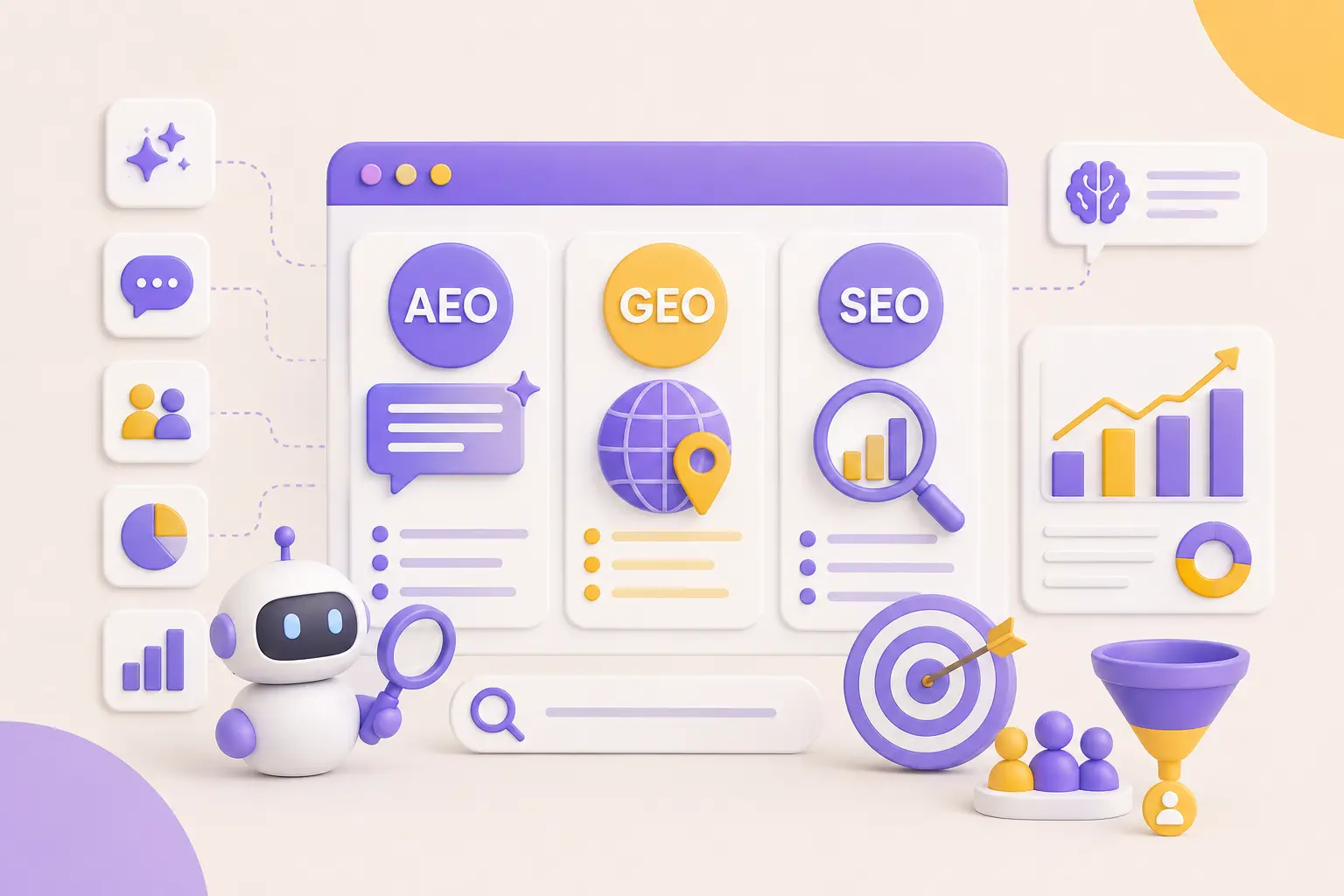
AEO vs GEO vs SEO: What Every B2B Marketer Needs to Know
Three years ago, B2B marketing teams had one organic search discipline to manage. Today they have three – SEO, AEO, and GEO – each with distinct signals, different content requirements, and separate measurement frameworks. The teams treating them as the same thing are investing in the wrong places. The ones that have separated them are building compounding advantage.
This guide is the clear breakdown your team needs: what each discipline actually is, how it differs from the others, where they overlap, and how to allocate resources across all three without spreading effort so thin it produces nothing.
| 40%+of informational B2B queries now trigger a Google AI Overview, bypassing organic click-through | 3 in 5B2B buyers use ChatGPT, Perplexity, or Gemini during the vendor research process | < 15%of B2B marketing teams currently run separate strategies for SEO, AEO, and GEO |
1. The definitions: SEO, AEO, GEO, and LLMO in plain language
Before the comparison, the definitions. Each term is being used loosely across the industry. Here’s what each one precisely means:
| SEO | Search Engine OptimisationGetting your website to rank in the organic results of traditional search engines |
SEO is the discipline most marketing teams know best. It optimises for ranking position in Google’s classic organic results – the blue links that appear beneath ads and above AI Overviews. The primary signals are: backlink authority, on-page relevance, technical health (crawlability, page speed, Core Web Vitals), and topical depth.
In 2026, classic SEO is still the highest-volume organic traffic channel for most B2B companies. Its influence on pipeline hasn’t diminished. What has changed is the share of queries where a click to your site is the default outcome – AI Overviews and direct answers intercept an increasing portion before the user reaches organic results.
| AEO | Answer Engine OptimisationGetting your content cited inside AI-generated answers on search engine result pages |
AEO targets the surfaces inside search engines that generate answers without requiring a click to your site. In Google’s case, this means AI Overviews (the synthesised answer box appearing above organic results), featured snippets, and voice search results. Bing’s Copilot integration operates similarly.
AEO optimisation focuses on: placing direct 2–3 sentence answers immediately below relevant headings, structuring content with FAQPage schema that mirrors on-page Q&A, maintaining heading hierarchies that match natural-language query phrasing, and building topical authority across a cluster of interlinked pages rather than relying on a single page.
A key distinction: AEO is about being cited inside the search engine. The user may see your brand in the answer without clicking to your site. For B2B marketing teams, this brand impression at a high-intent moment has real value even without a recorded session in GA4.
| GEO | Generative Engine OptimisationGetting your content cited by AI tools when users ask research, comparison, or evaluation questions |
GEO operates outside of traditional search engines entirely. It targets the answers generated by ChatGPT, Perplexity, Claude, Gemini, and similar AI tools when users ask research-style questions. These tools retrieve content from the web using retrieval-augmented generation (RAG), synthesise it, and present a generated answer that may cite specific sources.
GEO optimisation focuses on: consistent entity naming across all on-site and external content, original data or frameworks that give AI systems a reason to cite your specific content, clean HTML structure that AI crawlers (GPTBot, PerplexityBot, ClaudeBot) can parse accurately, and topical depth signals that help AI systems classify your domain as authoritative on a subject.
The GEO measurement challenge is significant: a significant portion of GEO value is delivered through brand mention in AI-generated answers that produce no trackable click. Marketing teams used to last-click or even multi-touch attribution will undercount GEO impact using standard analytics.
| ✺ WHAT ABOUT LLMO?LLMO (Large Language Model Optimisation) describes the broader discipline of shaping how LLMs represent your brand, products, and expertise in their training data and retrieval systems. GEO focuses on retrieval – being cited in real-time AI-generated answers. LLMO includes training data influence, which operates on a longer timeline and through a different set of signals (external authority, original research, third-party citations).For most B2B marketing teams in 2026, GEO is the actionable short-to-medium-term discipline. LLMO is the longer-arc brand investment running in parallel. This guide focuses on GEO as the operational priority. |
2. How each discipline works: retrieval, ranking, and citation
The mechanism behind each discipline determines what you optimise. Get the mechanism wrong and you’re applying the right effort to the wrong signals.
| Discipline | Mechanism | What the system looks for | Output for the user |
| SEO | Crawl → index → rank. Google crawls pages, indexes content, and ranks pages against queries using hundreds of signals. | Backlink authority, keyword relevance, technical health, topical depth, page experience signals (Core Web Vitals). | A ranked list of organic results. User clicks through to your site. |
| AEO | Crawl → index → retrieve → synthesise. Google retrieves relevant indexed pages and uses an LLM to generate a synthesised answer. | Direct-answer text structure, FAQPage schema accuracy, heading hierarchy matching query intent, domain topical authority. | A synthesised answer box (AI Overview) above organic results. May include a source link. Often no click required. |
| GEO | Crawl → retrieve → synthesise (RAG). AI tools fetch live web content at query time, use it as context, and generate an answer. | Clean HTML parsability, entity consistency, topical depth across a domain, original data/frameworks, source credibility signals. | A generated answer in ChatGPT, Perplexity, Claude, etc. May include source citations. User may or may not visit the cited site. |
The practical implication: SEO and AEO share the same Google index as their starting point. Content that ranks well in classic SEO has a meaningful head start for AEO, because it’s already trusted by Google’s crawl systems. GEO operates independently – a page that ranks on page 3 of Google can still be cited by Perplexity if it covers a specific question with strong structural clarity and entity signals. This creates both a risk (poor classic SEO doesn’t preclude GEO entirely) and an opportunity (GEO investment is accessible even for domains with moderate domain authority).
3. The side-by-side comparison every marketer needs
| Factor | SEO | AEO | GEO |
| Primary surface | Google organic results (blue links) | Google AI Overviews, Bing Copilot, featured snippets, voice | ChatGPT, Perplexity, Claude, Gemini, Copilot (standalone) |
| Output for user | Ranked list; user clicks through to your site | Synthesised answer; source link may or may not be shown | Generated answer; source citation often visible in Perplexity |
| Traffic to your site | Direct – every ranking drives potential clicks | Partial – AI Overview may reduce clicks on same query | Indirect – citation may or may not drive a click |
| Primary signals | Backlinks, keyword relevance, technical health, CWV | Answer structure, FAQPage schema, heading hierarchy, authority | Entity clarity, HTML parsability, topical depth, original data |
| Schema priority | Standard (title, meta, breadcrumb) | FAQPage, Article, HowTo – these drive Overview selection | Organization, Article, FAQPage, SoftwareApplication |
| Content format that wins | Well-optimised long-form with strong backlink profile | Direct-answer openings; FAQ sections; structured H2/H3 | Extractable paragraphs; original claims; named frameworks |
| Timeline to results | 3–6 months for competitive terms | 4–8 weeks after schema and structure changes | 4–12 weeks; varies by how frequently AI tools re-crawl |
| Measurable in GA4 | Yes – organic sessions, conversions | Partially – Overview impressions in GSC; click data limited | Partially – referral traffic from Perplexity/ChatGPT trackable |
| Budget intensity | High – content, links, technical | Moderate – content structure + schema changes to existing pages | Moderate – entity standardisation + content depth investment |
| B2B marketing priority | Foundational – must run always | High and growing – AI Overviews now affect most B2B info queries | High and emerging – buying committee research increasingly AI-assisted |
4. Where the three disciplines overlap and where they diverge
Where they share the same foundation
All three disciplines start with the same prerequisite: a technically sound, crawlable website with clean HTML, correct canonical structure, and accurate schema. A robots.txt that blocks AI crawlers hurts GEO and AEO simultaneously. JavaScript rendering failures affect classic Google indexing and AI retrieval equally. Core Web Vitals matter for both user experience and crawler completion rates across all three systems.
Topical authority also lifts all three. A domain that has built systematic coverage of a subject area – pillar page, cluster pages, interlinked with descriptive anchors – performs better in classic SERP rankings, earns more AI Overview citations, and gets retrieved more reliably by external AI tools. The content architecture investment is shared.
Where they diverge
The divergence is in content structure and signal weighting. A page optimised for classic SEO may rank on page 1 without ever appearing in an AI Overview, because it buries the direct answer deep in the content and has no FAQPage schema. That same page may not be cited by Perplexity because its HTML is cluttered and its entity naming is inconsistent.
| Optimisation action | Helps SEO | Helps AEO | Helps GEO |
| High-authority backlink acquisition | ✓ Direct | ✓ Indirect (authority) | ✓ Indirect (authority) |
| FAQPage schema implementation | ✓ Minor | ✓ Critical | ✓ Moderate |
| Direct 2–3 sentence answer below H1 | ✓ Moderate | ✓ Critical | ✓ Critical |
| Entity name standardisation across site | ○ Minimal | ✓ Moderate | ✓ Critical |
| Clean HTML / SSR rendering | ✓ Moderate | ✓ Moderate | ✓ Critical |
| Robots.txt allowing AI crawlers | ○ N/A | ○ N/A | ✓ Critical |
| Original research / benchmark data | ✓ Moderate | ✓ Moderate | ✓ Critical |
| Topical cluster architecture | ✓ Critical | ✓ High | ✓ High |
| Page speed optimisation (LCP < 2.5s) | ✓ Moderate | ✓ Moderate | ✓ Moderate |
| Crunchbase / Wikidata / external profile accuracy | ○ Minimal | ○ Minimal | ✓ High |
5. How B2B buyers interact with all three surfaces
B2B buyers move across SEO, AEO, and GEO surfaces within a single buying cycle – often within a single research session. Understanding which surface they use at each stage is the foundation of a properly allocated multi-channel organic strategy.
| Buying stage | Typical search behaviour | Surface used | What your brand needs there |
| Problem definition | Typing a symptom or failure into Google: “why is our sales pipeline accuracy declining” | SEO (organic) + AEO (AI Overview on the query) | A well-ranked, direct-answer article on that specific problem |
| Category education | Asking ChatGPT or Perplexity: “explain revenue intelligence platforms and how they differ from CRM” | GEO (LLM answer) | Your brand and category definition cited in the generated answer |
| Vendor shortlisting | Googling: “best revenue intelligence software for mid-market sales teams” | SEO + AEO (AI Overview on category queries) | Ranking in classic SERP + citation in AI Overview on that query |
| Competitive comparison | Asking Perplexity: “[Vendor A] vs [Vendor B] for enterprise B2B” | GEO (Perplexity or ChatGPT with browsing) | Your comparison page cited as a source in the generated comparison |
| Internal justification | Googling: “ROI of revenue intelligence platforms for B2B sales” | SEO + AEO | A business-case page with specific benchmarks ranking and cited in AI Overview |
| Final validation | Googling: “[Your brand] reviews” or “[Your brand] vs [Competitor]” | SEO (branded organic) | Your own comparison page ranking above G2 and Capterra on branded comparison queries |
| ✺ THE CRITICAL IMPLICATION FOR B2B MARKETERSA B2B buyer evaluating your product may encounter your brand through six separate search events before a sales conversation – and those events are distributed across classic SERP, Google AI Overviews, and external AI tools. A strategy that optimises for only one of these surfaces captures one event and misses five. The ROI case for investing across all three disciplines is a coverage argument, not just a traffic argument. |
6. Which discipline to prioritise and when
The right prioritisation depends on your current situation. Here’s the framework, by scenario:
| 01 | You have weak organic foundations (DA < 25, few rankings)Start with SEO. AEO and GEO both benefit from the same technical and content foundations that classic SEO requires. Building topical authority through a cluster architecture, fixing technical crawl issues, and producing substantive content on your core topics lifts all three disciplines simultaneously. Investing in GEO-specific entity work before you have solid technical SEO is building the upper floors before the ground floor is stable. |
| 02 | You rank well but traffic from informational queries is decliningAdd AEO. If your existing rankings are producing fewer clicks than they did 12 months ago on informational queries, AI Overviews are the most likely cause. Audit which of your ranking pages are being intercepted by Overviews and audit whether you’re cited in them. The fix is structural: direct answers early in the content, FAQPage schema, heading hierarchy that matches query phrasing. This is an AEO intervention applied to existing SEO-performing content. |
| 03 | Your buyers use AI tools heavily in research (confirmed by sales team)Invest in GEO alongside SEO. If your sales team reports that prospects are arriving having already formed opinions about your category from ChatGPT or Perplexity, your GEO presence is already influencing pipeline. Audit your entity representation in AI tools, standardise entity naming across all content, and add direct-answer structure to your most important pages. GEO investment produces returns faster than SEO on competitive terms because it doesn’t depend on backlink accumulation. |
| 04 | You compete in a regulated or niche vertical (FinTech, cybersecurity, healthcare tech)Prioritise GEO with vertical-specific depth content. Regulated B2B verticals have compliance, regulation, and certification queries that buyers increasingly research through AI tools. A FinTech vendor with authoritative content on PSD2, FCA authorization, and PCI DSS will be cited in regulatory-context AI answers in ways a generic financial technology vendor won’t. Build vertical-specific cluster content with direct-answer structure and let it compound across both AEO and GEO surfaces. |
| 05 | You have strong SEO and AEO performance but limited GEO presenceRun a targeted GEO programme. Audit your entity representation in ChatGPT, Perplexity, and Gemini explicitly. Check: does the AI accurately describe what your company does? Does it mention your product in relevant category comparisons? Fix entity inconsistencies, add original research to key pages, ensure GPTBot and PerplexityBot are allowed in robots.txt, and implement Organization and SoftwareApplication schema. This is an optimization programme on an existing strong content base. |
7. Building the integrated strategy
Running SEO, AEO, and GEO as separate workstreams with separate teams is operationally inefficient. The disciplines share enough infrastructure that an integrated programme produces better results with lower resource duplication.
Here’s how the integrated programme works in practice:
| ✺ SHARED FOUNDATIONTechnical layer (serves all three)Clean crawlable HTML, correct robots.txt for all crawlers, fast page load (LCP < 2.5s), canonical structure, sitemap accuracy. Fix once, lift all three disciplines simultaneously. Audit quarterly. | ✺ SHARED FOUNDATIONContent architecture (serves all three)Pillar + cluster structure with descriptive internal linking. A well-built topic cluster raises classic rankings, builds topical authority for AI Overview citation, and signals domain expertise to GEO retrieval systems. |
| ✺ AEO-SPECIFIC LAYERAnswer structure + schemaDirect 2–3 sentence answers below H1/H2 headings. FAQPage schema on blog, pillar, and service pages. Article schema on all content. HowTo schema on step-by-step guides. These additions to existing content are low-effort and high-impact for AEO. | ✺ GEO-SPECIFIC LAYEREntity standardisation + original dataConsistent entity naming across all pages, schema blocks, and external profiles. At least one piece of original data, a proprietary framework, or a named benchmark on each key page. These are the citation anchors that give AI tools a specific reason to reference your content over a competitor’s. |
| ✺ SEO-SPECIFIC LAYERAuthority and backlink programmeExternal link acquisition remains the most decisive signal for classic SERP ranking that AEO and GEO don’t require in the same way. A focused backlink programme on pillar pages and high-priority comparison pages is the SEO-specific investment that doesn’t overlap. | ✺ MEASUREMENT LAYERCross-discipline trackingGSC for classic ranking and AI Overview impressions. GA4 + CRM for organic pipeline influence. Monthly manual citation audit for GEO. Quarterly entity representation check in ChatGPT and Perplexity. One integrated reporting dashboard, not three separate ones. |
8. Measuring performance across all three disciplines
Standard marketing analytics was built for a world where organic traffic meant a click. The multi-surface reality of 2026 requires a measurement framework that accounts for impressions and citations that produce no trackable session.
| Discipline | Primary metric | Secondary metrics | Tool | Reporting cadence |
| SEO | Organic sessions + qualified leads from organic | Keyword rankings by cluster; organic conversion rate by page; assisted conversions in GA4 | Google Search Console, GA4, Ahrefs / Semrush, CRM integration | Weekly rank check; monthly pipeline report |
| AEO | AI Overview impressions + share of cited pages | Featured snippet position; click-through rate on Overview-intercepted queries; GSC impression share | Google Search Console (AI Overview filter); manual query audit | Monthly Overview impression report; quarterly content audit |
| GEO | Brand mention rate in AI tool answers (manual audit) | AI-referred referral traffic in GA4; entity accuracy score; citation quality (source or mention) | GA4 (referral source filter for Perplexity/ChatGPT); monthly manual citation audit spreadsheet | Monthly manual audit; quarterly entity accuracy check |
| ✺ THE MEASUREMENT GAP TO ACCEPTA portion of GEO and AEO value is unmeasurable with current tools – specifically, the brand awareness generated by citations and mentions in AI-generated answers that produce no click. This is structurally similar to radio advertising or event sponsorship: real value, untrackable in analytics. Marketing teams that refuse to invest in AEO or GEO until they can prove direct attribution will underinvest in these surfaces until competitors have built compounding advantages. Set a budget line for AI search optimization and measure what you can, accepting that full attribution isn’t available yet. |
9. The most common mistakes marketing teams make
Here are the B2B SEO Mistakes:
Mistake 1: Treating AEO and GEO as advanced SEO
The framing of AEO and GEO as “SEO 2.0” leads teams to believe they need to master classic SEO fully before approaching the other disciplines. The reality: AEO and GEO have some unique requirements (direct-answer structure, entity standardisation, schema specifics) that can be addressed in parallel with classic SEO work. A mid-sized B2B company with moderate rankings should be running all three disciplines simultaneously, at different resource weights.
Mistake 2: Publishing AEO/GEO content without fixing technical access
Producing answer-optimised content on pages that GPTBot or PerplexityBot can’t crawl is wasted effort. Check robots.txt first. Then confirm key pages render fully for crawlers that don’t execute JavaScript. These two checks take an hour and determine whether all subsequent GEO effort reaches its target.
Mistake 3: Optimising schema without matching on-page content
FAQPage schema that includes questions and answers not visible on the page is a Google quality signal violation. It produces worse AI Overview citation, not better. Schema must reflect on-page content exactly – both the question text and the answer text. Audit this after every page update.
Mistake 4: Measuring GEO with last-click attribution
A B2B buyer who reads a Perplexity answer citing your brand and then directly types your URL three days later gets attributed to Direct in standard GA4 setups. Last-click attribution makes GEO look like it produces no traffic. Set up referral source tracking specifically for Perplexity, ChatGPT, and similar tools, and accept that a significant portion of GEO impact will remain in the unmeasured brand awareness bucket.
Mistake 5: Running AEO and GEO as a one-time project
AI search surfaces update constantly. Google’s AI Overview sourcing changes as the index evolves. LLMs re-crawl content on varying schedules. Entity representation in AI tools reflects the most recently available web signals. AEO and GEO require the same ongoing maintenance as classic SEO – monthly audits, quarterly content reviews, and continuous schema validation. Teams that launch a GEO programme and stop after six weeks build nothing that compounds.
10. FAQ
What is the difference between AEO, GEO, and SEO?
SEO (Search Engine Optimisation) gets your pages ranked in traditional Google organic results that users click through to. AEO (Answer Engine Optimisation) gets your content cited inside AI-generated answers on search engine results pages – primarily Google’s AI Overviews – where the user may receive an answer without clicking to your site. GEO (Generative Engine Optimisation) gets your content cited by external AI tools like ChatGPT, Perplexity, and Claude when users ask research or comparison questions. All three disciplines share technical foundations but diverge in content structure, schema requirements, and measurement approach.
Which is more important for B2B marketing: SEO, AEO, or GEO?
All three matter, but at different weights depending on your situation. Classic SEO remains the highest-volume organic channel and the foundation the other two depend on. AEO is the highest near-term priority adjustment for most B2B marketing teams because Google AI Overviews are already reducing click-through on informational queries that previously drove traffic. GEO is the fastest-growing area of B2B buyer research behaviour and the most underprepared surface for most companies. The right answer is an integrated programme that allocates the majority of resource to SEO fundamentals, with dedicated investment in AEO content structure and GEO entity work running simultaneously.
Can you optimise for all three at the same time?
Yes – and the most efficient approach is to build a shared foundation that serves all three. Topic cluster architecture, technical crawl health, and direct-answer content structure all lift SEO, AEO, and GEO simultaneously. The discipline-specific additions are relatively lightweight on top of that foundation: FAQPage schema and heading restructuring for AEO, entity standardisation and robots.txt configuration for GEO. Running all three in parallel with a shared content team is more efficient than running them sequentially.
How do you measure GEO performance when there’s no click data?
GEO performance is measured through a combination of trackable and non-trackable signals. Trackable: referral traffic from Perplexity and ChatGPT (both pass referrer data), branded search volume trend in GSC, and entity accuracy in AI tool responses. Non-trackable: brand mentions in AI answers that produce no click. The non-trackable portion is structurally similar to brand awareness from offline channels – real value that can’t be attributed in analytics. The practical approach is a monthly manual audit: query your top 15 target terms in ChatGPT, Perplexity, and Google, and record citation status and accuracy. Track this alongside your trackable signals to build a directional picture of GEO performance.
How long does it take to see results from AEO and GEO?
AEO changes – adding direct-answer structure, FAQPage schema, and heading restructuring to existing pages – typically show AI Overview citation improvement within 4–8 weeks as Google re-crawls and re-evaluates the updated pages. GEO results depend on how frequently specific AI tools re-crawl your domain: Perplexity tends to update quickly (days to weeks for high-priority domains), ChatGPT’s browsing index updates on a variable schedule. Entity standardisation effects in GEO manifest over 4–12 weeks. Neither discipline delivers results as slowly as competitive classic SEO on high-authority terms, which is part of their strategic value.
| ✺ THE STARTING POINTThis week: run a manual citation audit across your top 10 target queries in Google AI Overviews, ChatGPT, and Perplexity. Map what you find against your current SEO rankings. The gap between where you rank and where you’re cited tells you exactly which disciplines need the most immediate investment. |
The Lemon Theory
Growth marketing – strategy, SEO/AEO/GEO, performance, content. thelemontheory.com
We build integrated SEO, AEO, and GEO strategies for B2B marketing teams – from audit through to implementation and measurement. Get in touch at thelemontheory.com.
Leave a Reply